Module name Deghost
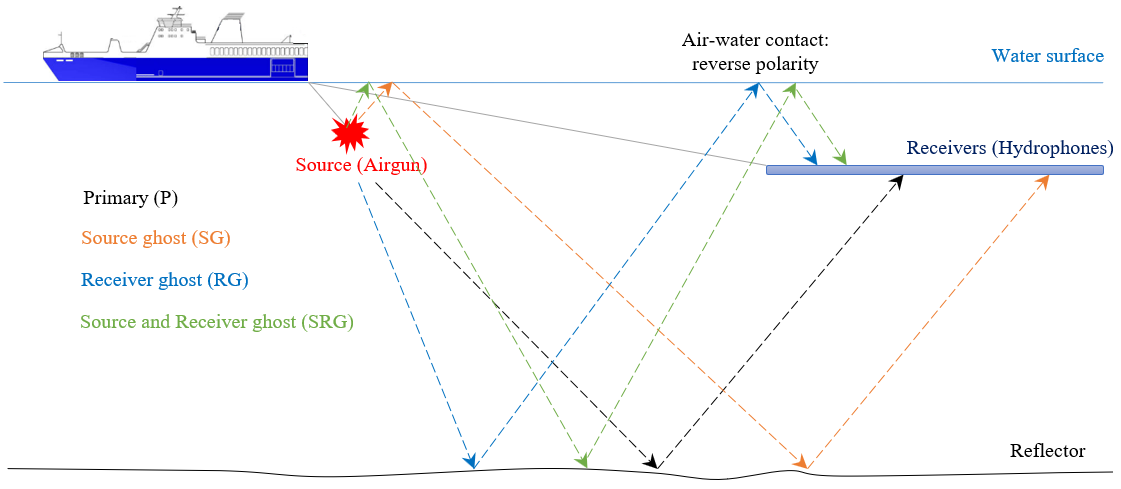
In marine seismic data it is an usual issue of the event interference: reflection and ghosts from source and receiver sides. The reason of existing ghost waves is that source (airgun) and receiver (streamer) are towed at some depth under the water level (usually 5-10 meters). A source ghost is an upgoing wave which then is reflected from the air-water contact with changing its polarity (*-1) and then goes downward with some time delay from the primary wave. Receiver ghost is almost the same as source, but it has only another direction a downgoing wave which was reflected at the air-water contact with changing its polarity and recorded by hydrophone (Fig.1).
Ghost waves contaminates the spectrum of conventional pressure seismic data reducing energy which is called as notches. where V is the velocity of wave in water and Depth is the source or receiver depth:
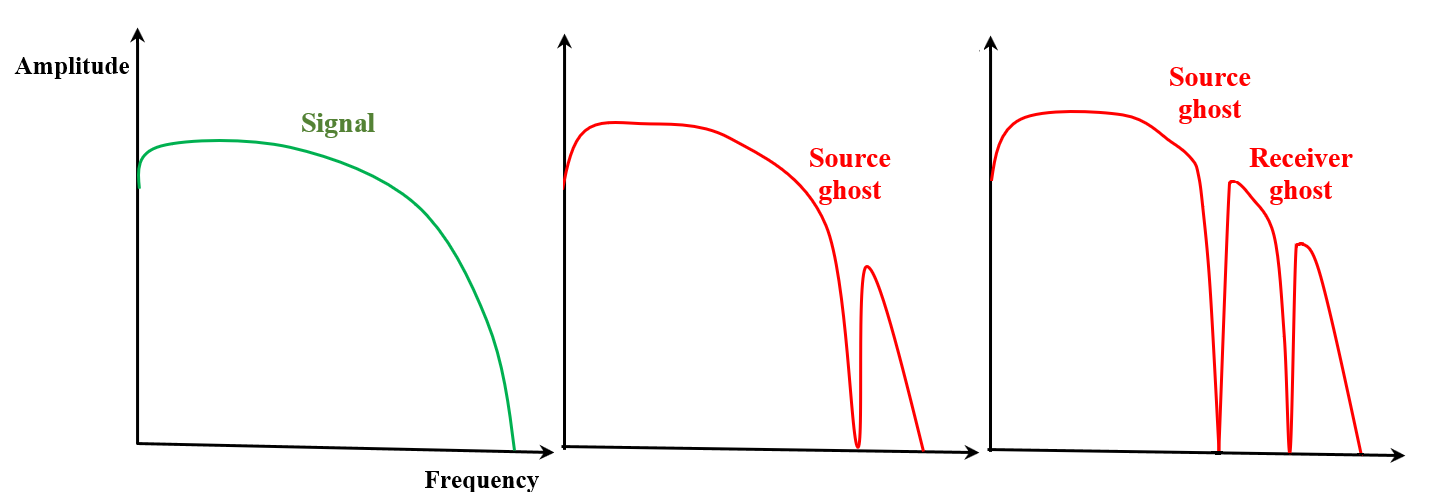
Amplitude frequency spectrum: primaries (left), primary+source ghost (middle) and primary+source and receiver ghost (right).
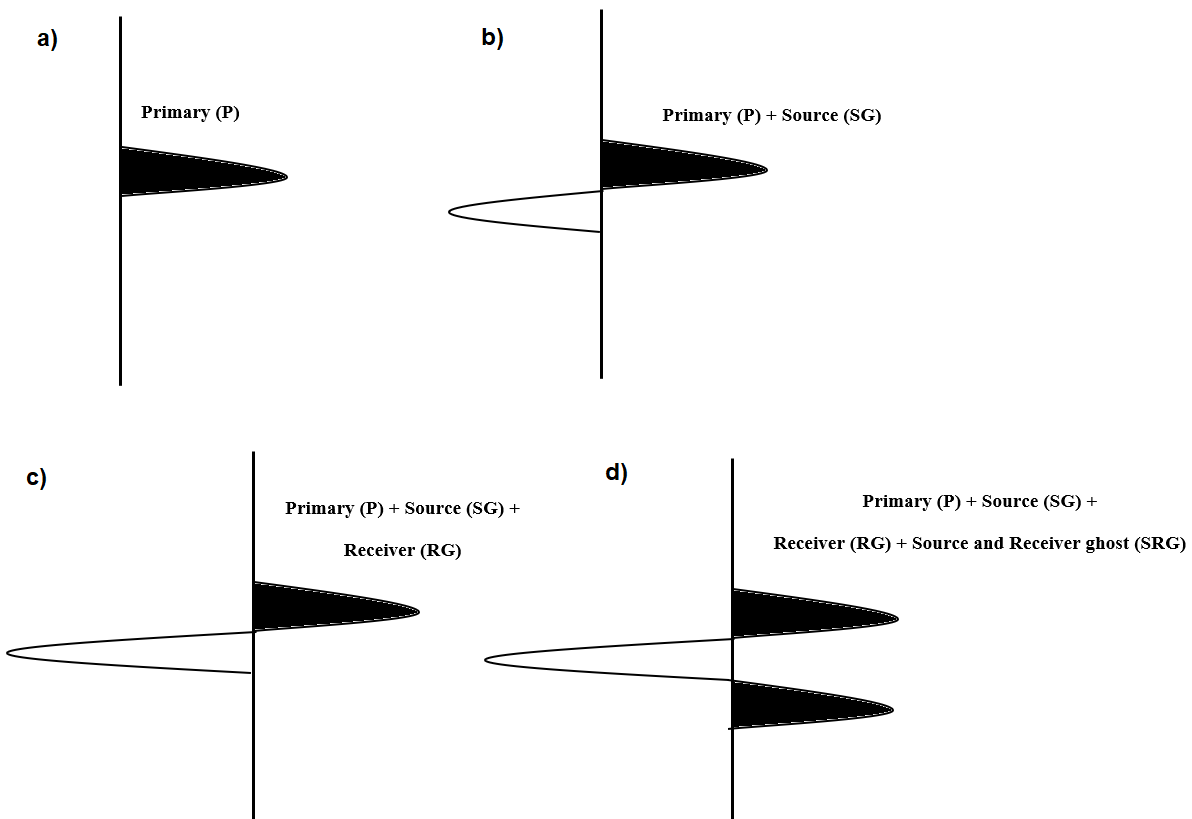
Wavelets: a) signal, b) signal + source side ghost, c) signal + source + receiver side ghost, d) signal + source + receiver sides ghost + source and receiver sides ghost.
Module Deghost uses f-k method to create ghost-wave model in domain and adaptively remove it from the input seismic data.
An example of the workflow for deghosting:
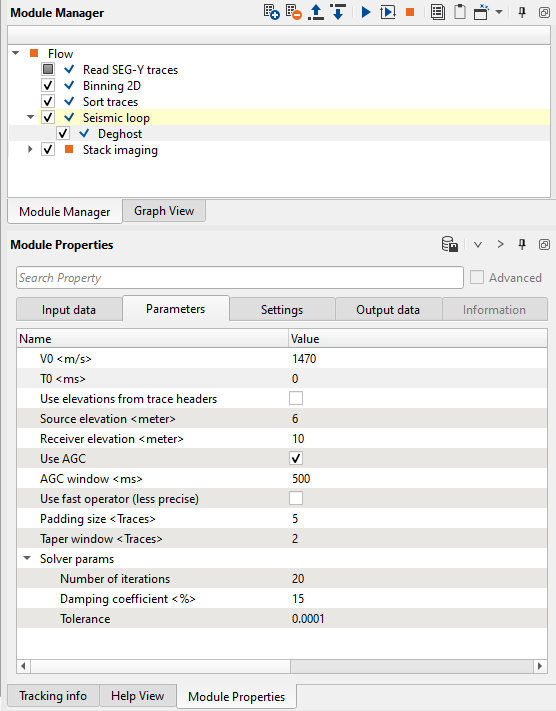
Workflow example with Deghost parameters.
The resulting seismic data is low frequency, due to ghosts attenuation. Therefore, it is usual practice to apply a Q-filter after deghosting procedure in order to increase amplitude of high frequencies.
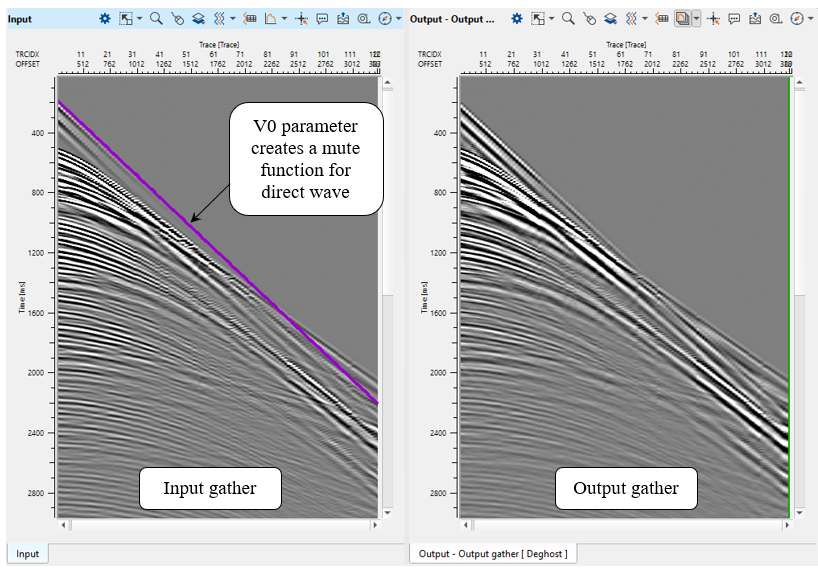
Source gather before (left) and after (right) deghosting procedure.
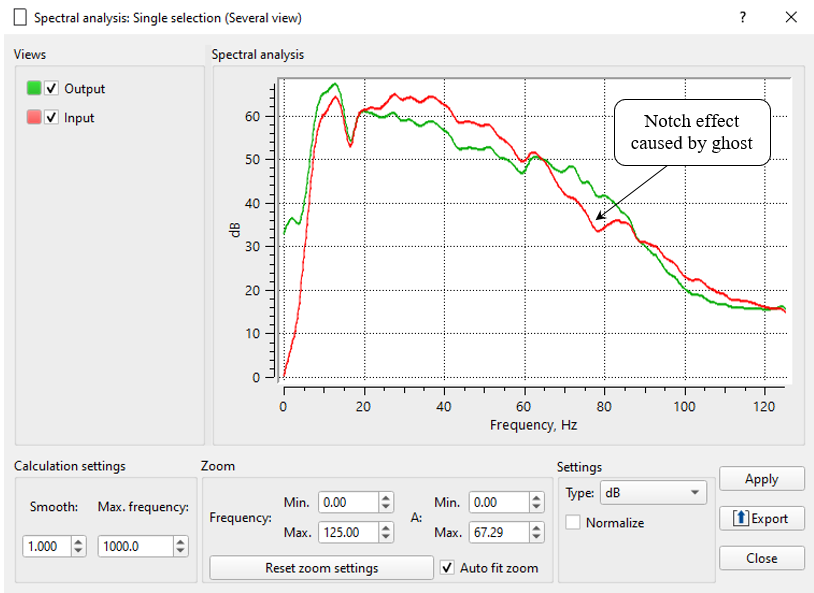
Amplitude frequency spectrum before (red) and after (green) deghosting procedure.