Module name Radon-TauP-High resolution
Conventional Radon demultiple algorithm has less quality in case of limitation in small moveout between primaries and multiples (near offsets), as well as when seismic data is aliased. Therefore, those limitats can be overcome by an upgrading of the usual Radon algorithm by enhancing the focusing of energy in the Tau-P domain. The result has better separation of primaries and multiples and better resistance to errors because of different types noise and aliasing.
In other words, High Resolution (HR) Radon module consist of two steps: Radon transform and enhance (focusing) events in Tau-P domain. The main basis is the same as Radon-TauP module has, i.e. this module transforms seismic traces into Tau/P (intercept time and slowness dt/dx = p) domain where we can easily separate multiples and primaries. Such separation allows to attenuate energy of multiple waves before reverse transformation into time domain (T-X). Basic idea is separation primaries and multiples by their velocity (moveout). Input traces are decomposed so hyperbolic events map to elliptical curves in Tau-P domain.
Input seismic gather must be sorted by Common Middle Point (CMP) - Offsets and the primaries should be flattened by applying Normal Move Out (stack velocity) correction before Radon transform. In this case the primary energy will be near P=0, which produces difference in moveout makes it possible to flatten the primary reflections while leaving the multiples under-corrected with a moveout approximately parabolic.
Slowness = 1 / Velocity
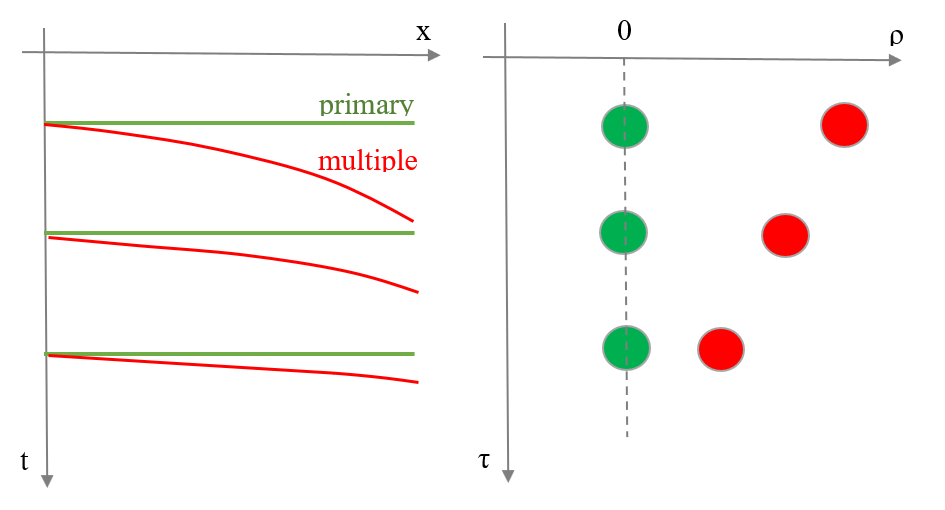
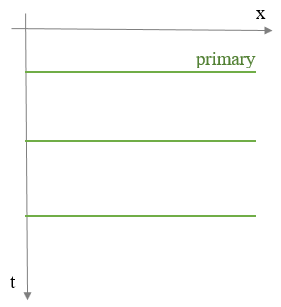
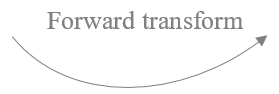
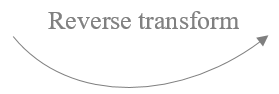
Figure 1. Model of CMP gather: 1) Time domain (T-X): Primaries+Multiples;
2) Tap-P domain: Primaries+Multiples:
3) Time domain (T-X): Primaries.
The module performs a model of primary and multiple events. This computation is based on data decomposition into user-defined parabolas and calculated by high-resolution algorithm, de-aliased least-squares method in the frequency space domain for every frequency of the pass-band which is defined by frequency min (Hz) and frequency max (Hz) parameters. Events corresponding to parabolas with a bigger curvature are considered as multiples. Events corresponding to parabolas smaller than this constrain are primary events. The area limits between primaries and multiples is user defined parametrization.
To avoid drawbacks of conventional Radon transform there was developed upgraded one decomposition is the HR Radon transform. HR Radon method does not have such limitations like conventional algorithm by constraining the parabolic decomposition of the data. These constrain the Radon spectra to be sparse in q and t, using a re-weighted iterative approach. It performs a sparse decomposition of the input seismic data and as result there are less events in the Radon domain, i.e. we have less artifacts due to the smoothing effect in Tau-P domain. The constraints have the effect of moving energy towards those locations where the standard transform has its larger amplitudes, which are predominantly where the energy would sit if there were no sampling or aperture limitations in the input data or in the transform itself. The high-resolution transform is capable, therefore, of better discriminating between primary and multiples and is also resistant to spatial aliasing of the input data.
Conventional Radon HR Radon
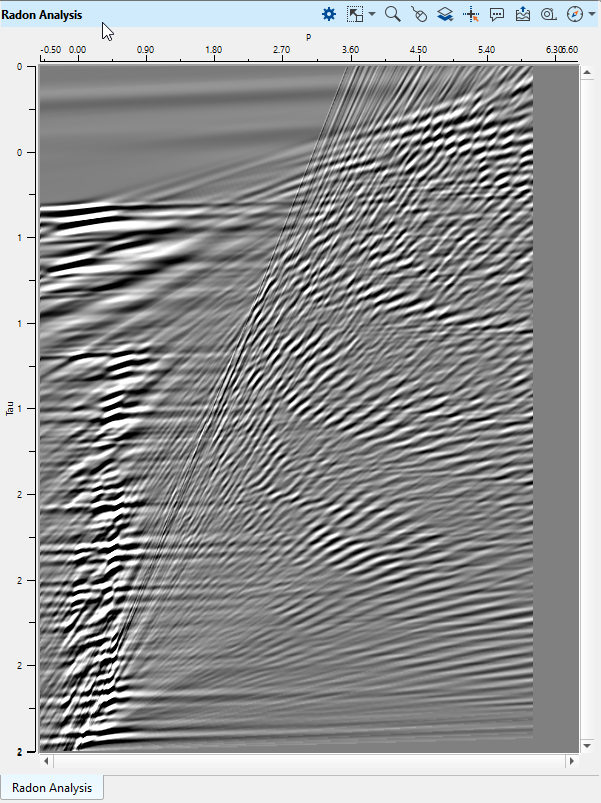
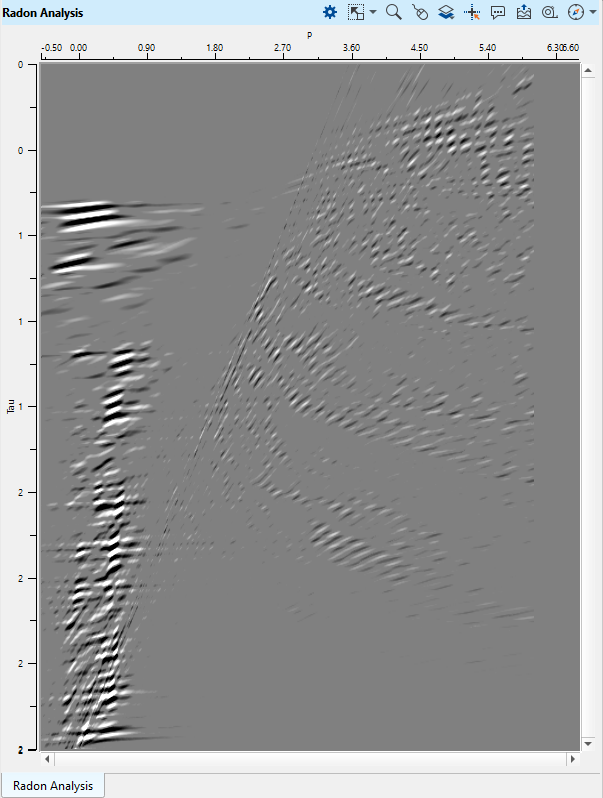
Tau-P transform, compare conventional (left) and high resolution (right).
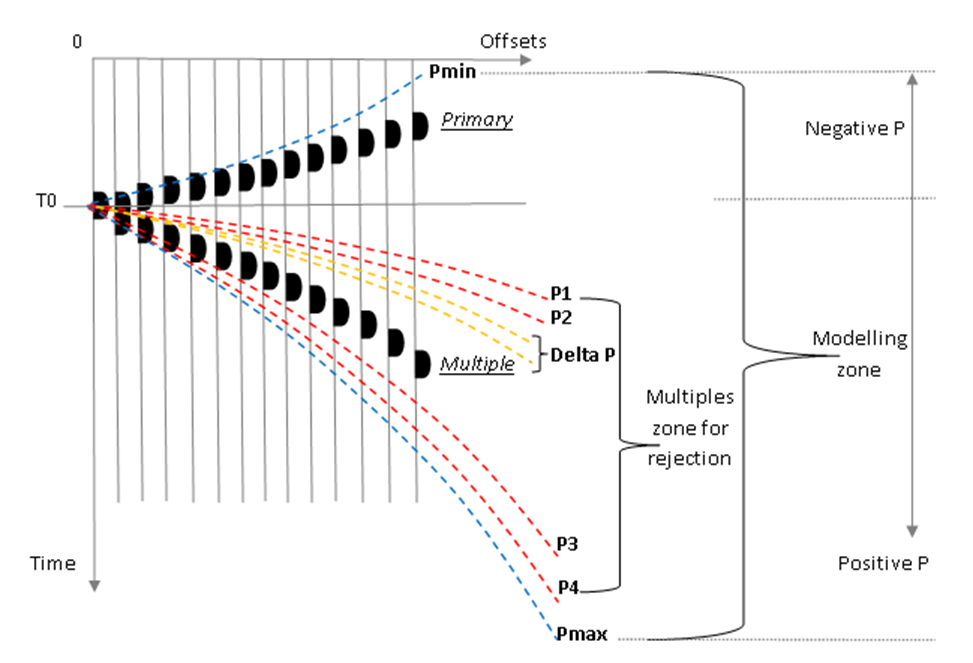
NMO-corrected (intermediate velocity) CMP gathers with main parameters. Note! primary reflection has over-correction for better separation from multiples, but it is not necessary to use special intermediate velocities over-correct hodograph. Also you can apply the final velocity to the CMP gathers for flattening primary reflection.
An example of the workflow for demultiples:
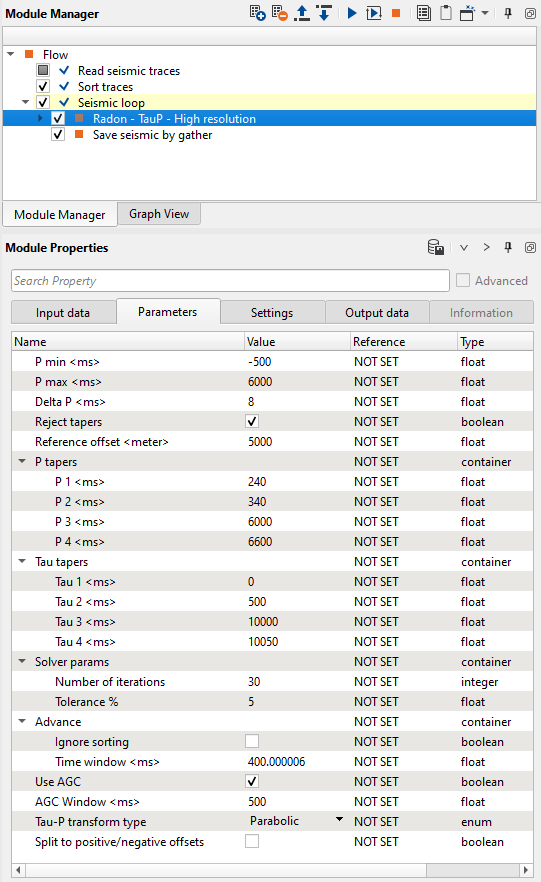
Interactive parameter testing that user can do on fly:
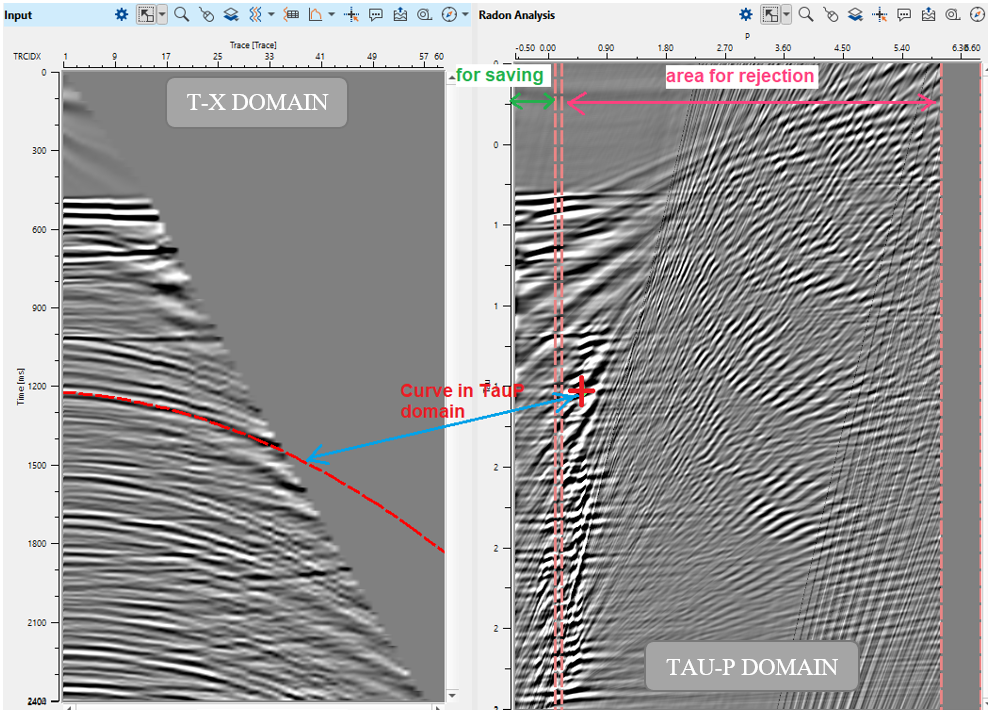
NMO-corrected CMP gather (left), its transform to the Tau-P domain (right).
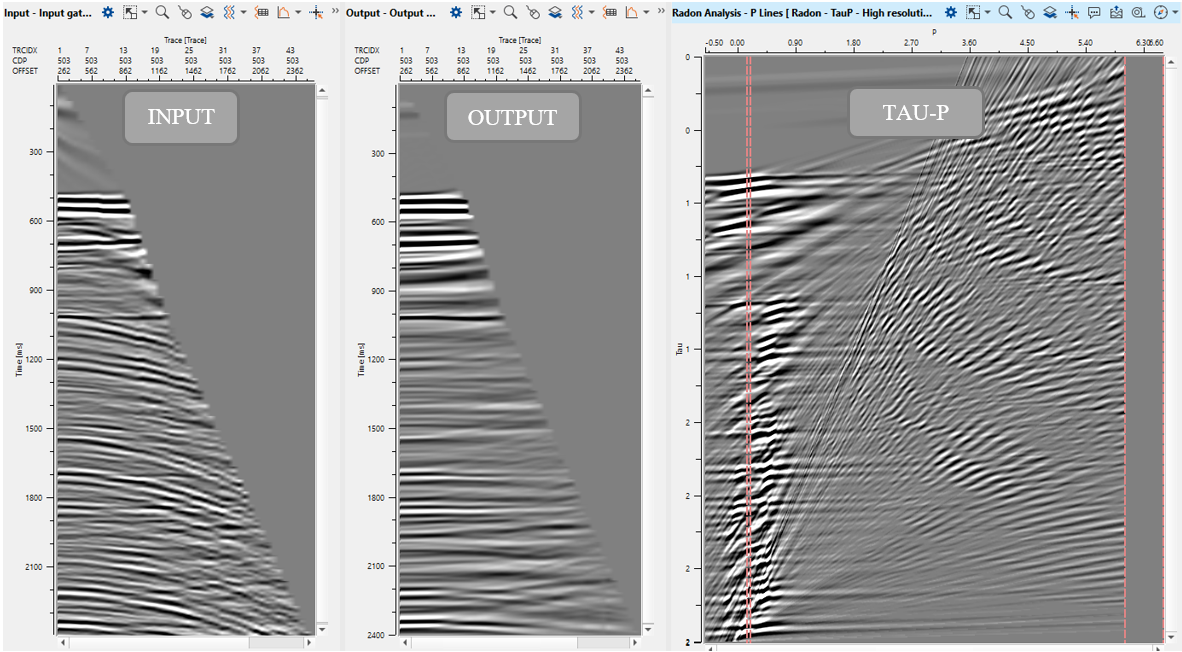
Quality control/Test parameters: Tolerance = 1%, Number of iterations = 2.
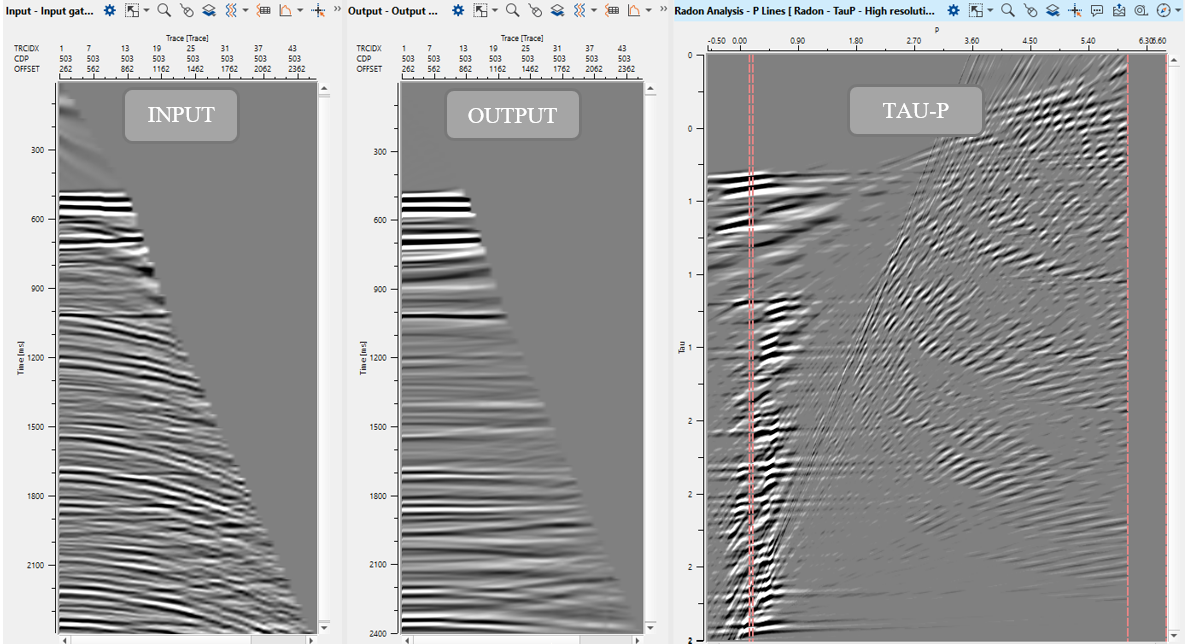
Quality control/Test parameters: Tolerance = 5%, Number of iterations = 2.
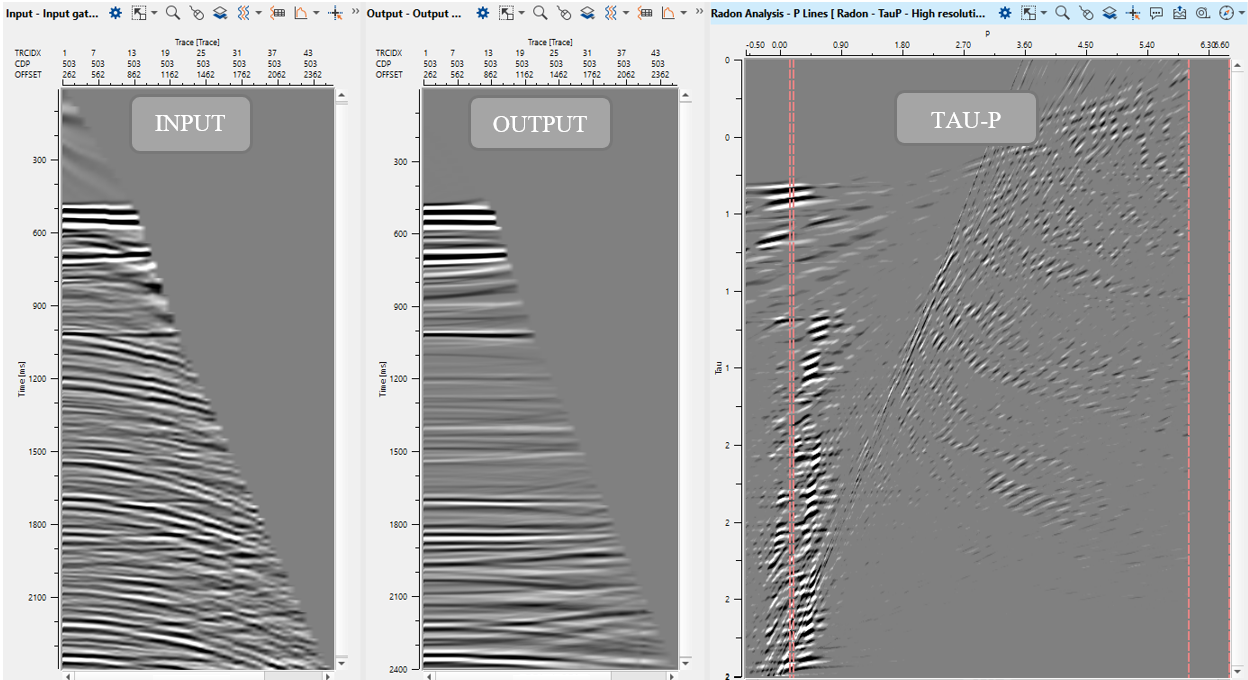
Quality control/Test parameters: Tolerance = 5%, Number of iterations = 32.
Interactive quality control on seismic gather (before and after) that user can do on fly:
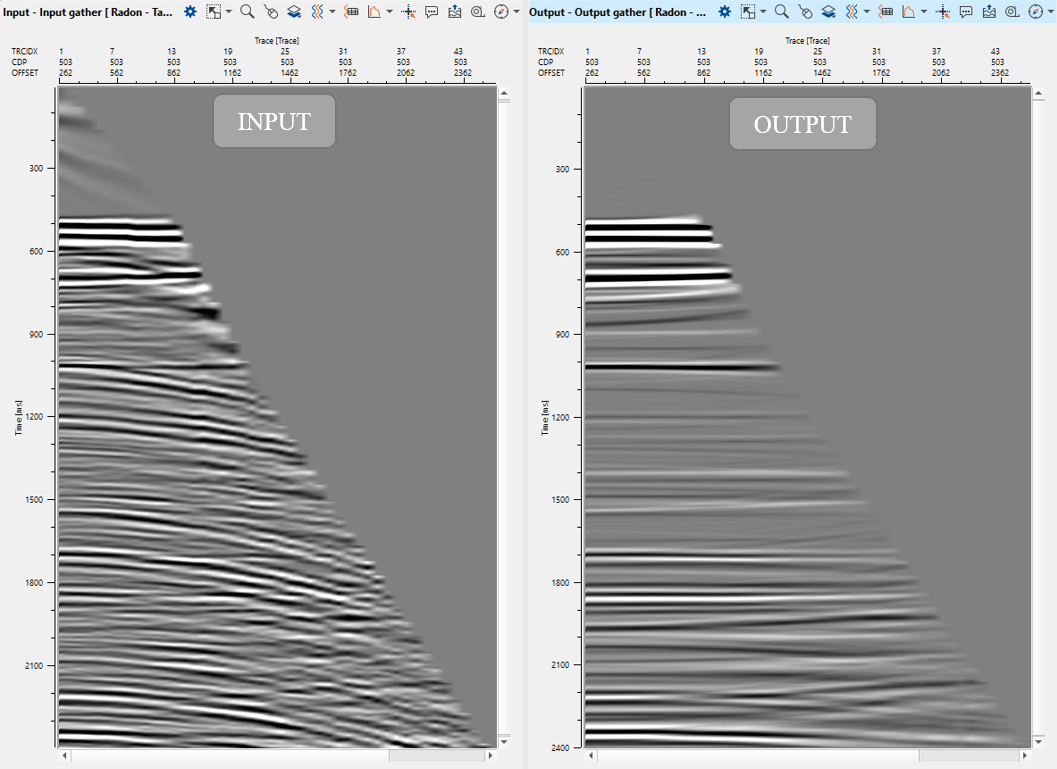
NMO-corrected CMP gather: Input (left), Output (right).
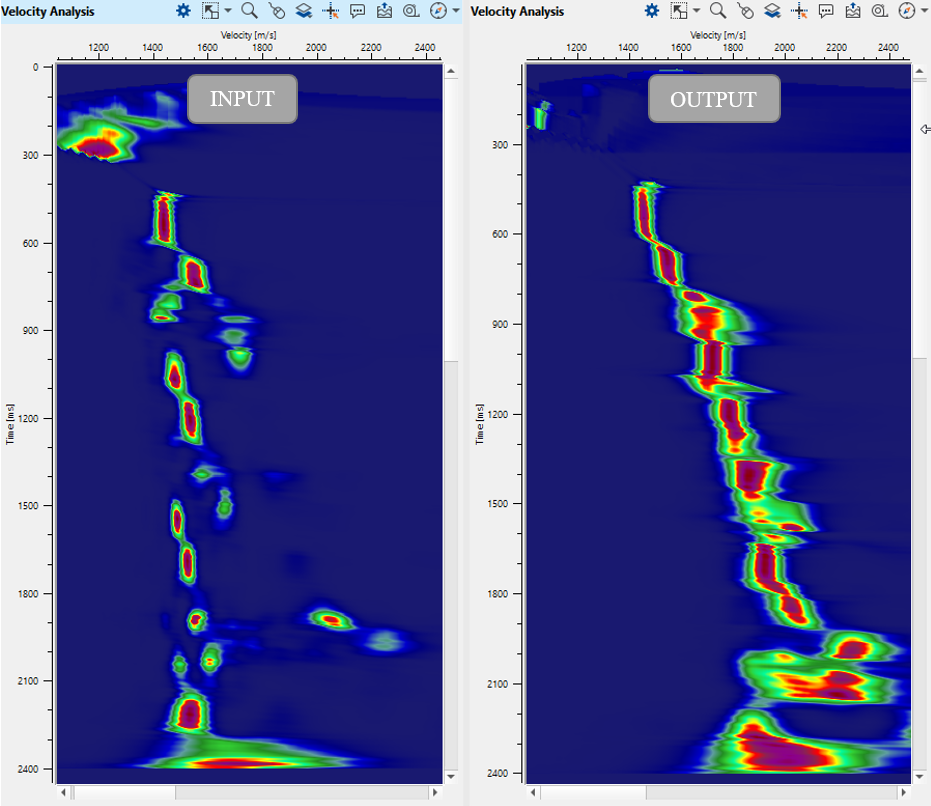
Velocity spectrum before multiple attenuation (left) and after (right).