Module name Radon-TauP
Radon-TauP module transforms seismic traces into Tau/P (intercept time and slowness dt/dx = p) domain where we can easily separate multiples and primaries. Such separation allows to attenuate energy of multiple waves before reverse transformation into time domain (T-X). Basic idea is separation primaries and multiples by their velocity (moveout). Input traces are decomposed to hyperbolic events map to elliptical curves in Tau-P domain.
Input seismic gather must be sorted by Common Middle Point (CMP) - Offsets and the primaries should be flattened by applying Normal Move Out (stack velocity) correction before Radon transform. In this case the primary energy will be near P=0, which produces difference in moveout makes it possible to flatten the primary reflections while leaving the multiples under-corrected with a moveout approximately parabolic.
Slowness = 1 / Velocity
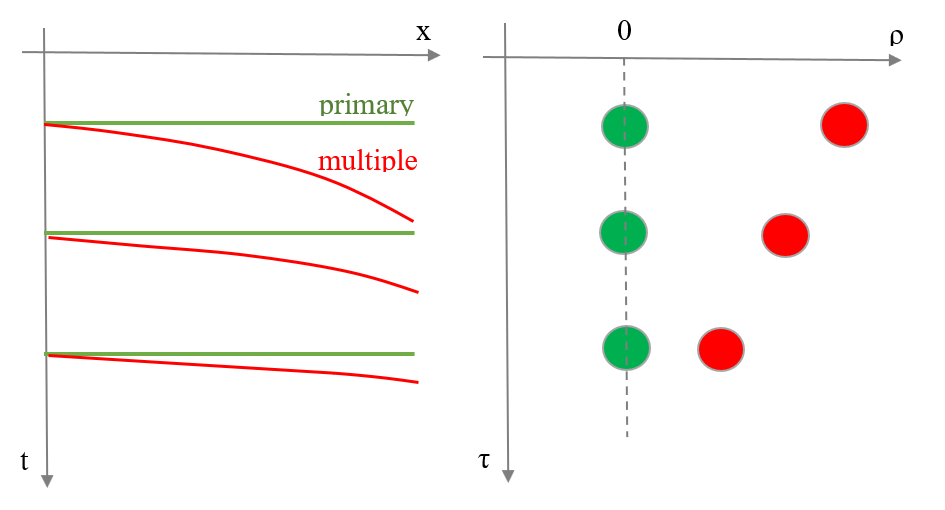
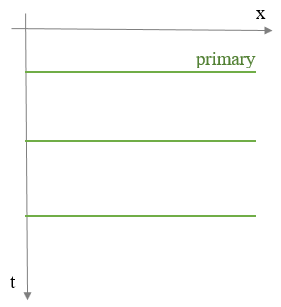
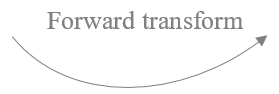
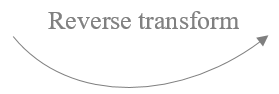
Model of CMP gather: 1) Time domain (T-X): Primaries+Multiples;
2) Tap-P domain: Primaries+Multiples:
3) Time domain (T-X): Primaries.
The module performs a model of primary and multiple events. This computation is based on data decomposition into user-defined parabolas and calculated by high-resolution algorithm, de-aliased least-squares method in the frequency space domain for every frequency of the pass-band which is defined by frequency min (Hz) and frequency max (Hz) parameters. Events corresponding to parabolas with a bigger curvature are considered as multiples. Events corresponding to parabolas smaller than this constrain are primary events. The area limits between primaries and multiples is user defined parametrization.
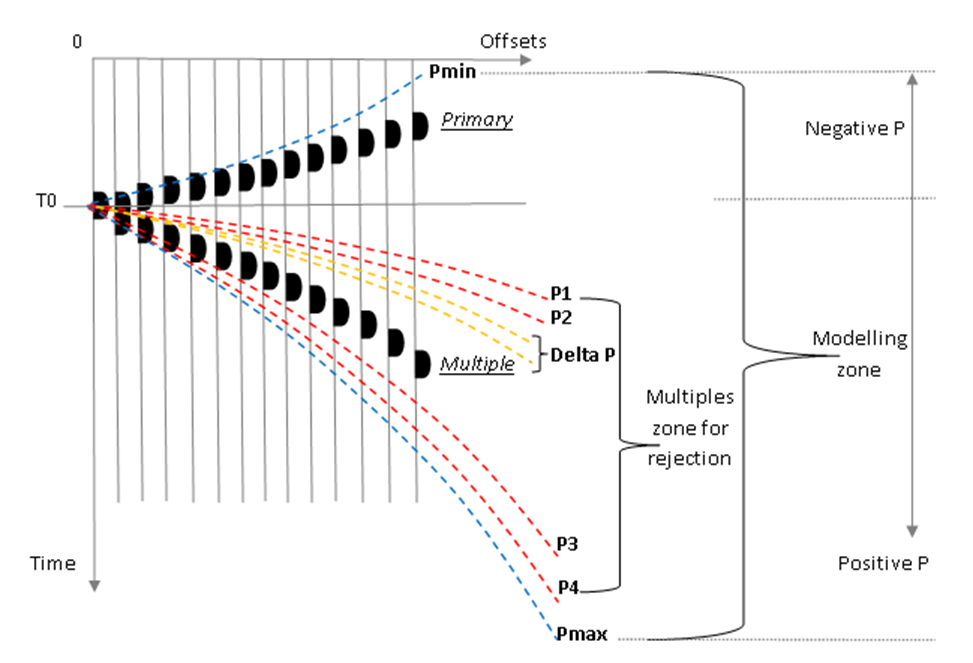
NMO-corrected (intermediate velocity) CMP gathers with main parameters.
An example of the workflow for demultiple:
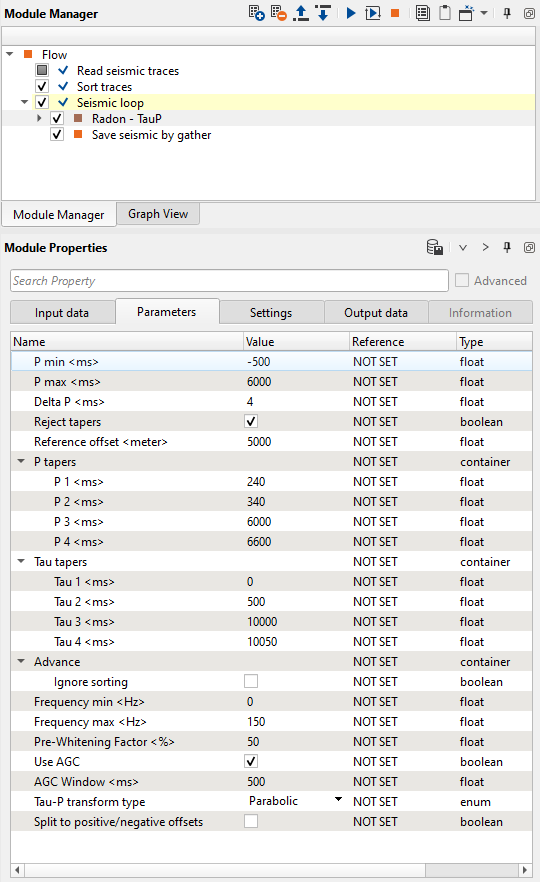
Interactive parameter testing that user can do on fly:
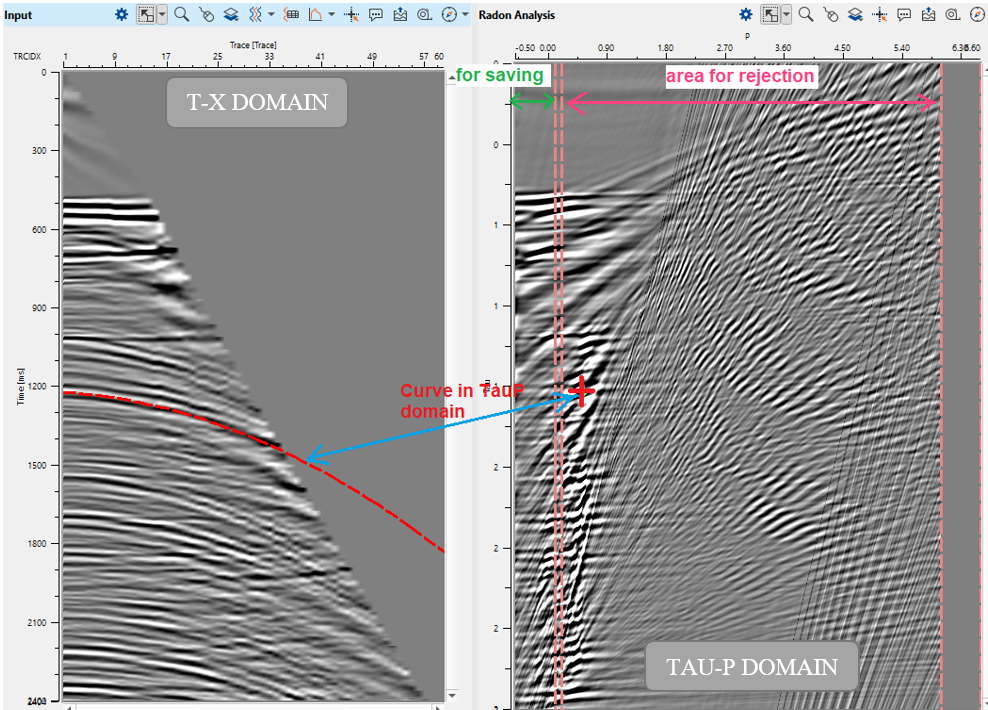
NMO-corrected CMP gather (left), its transform to the Tau-P domain (right).
Interactive quality control on seismic gather that user can do on fly:
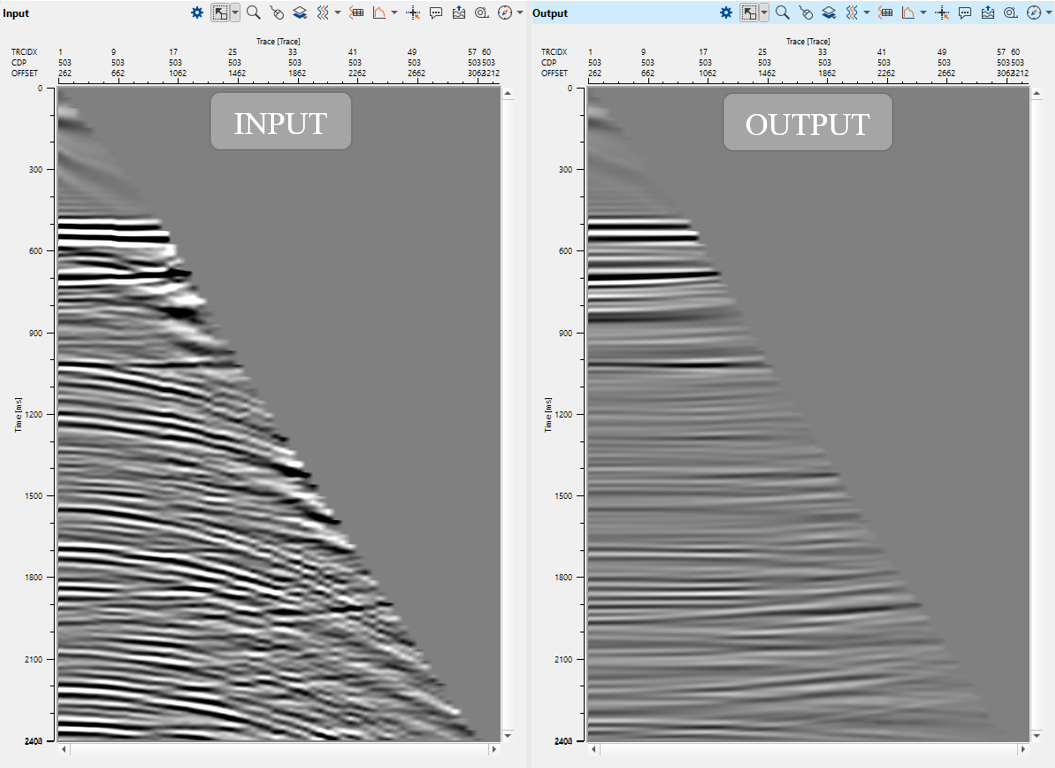
NMO-corrected CMP gather: Input (left), Output (right).
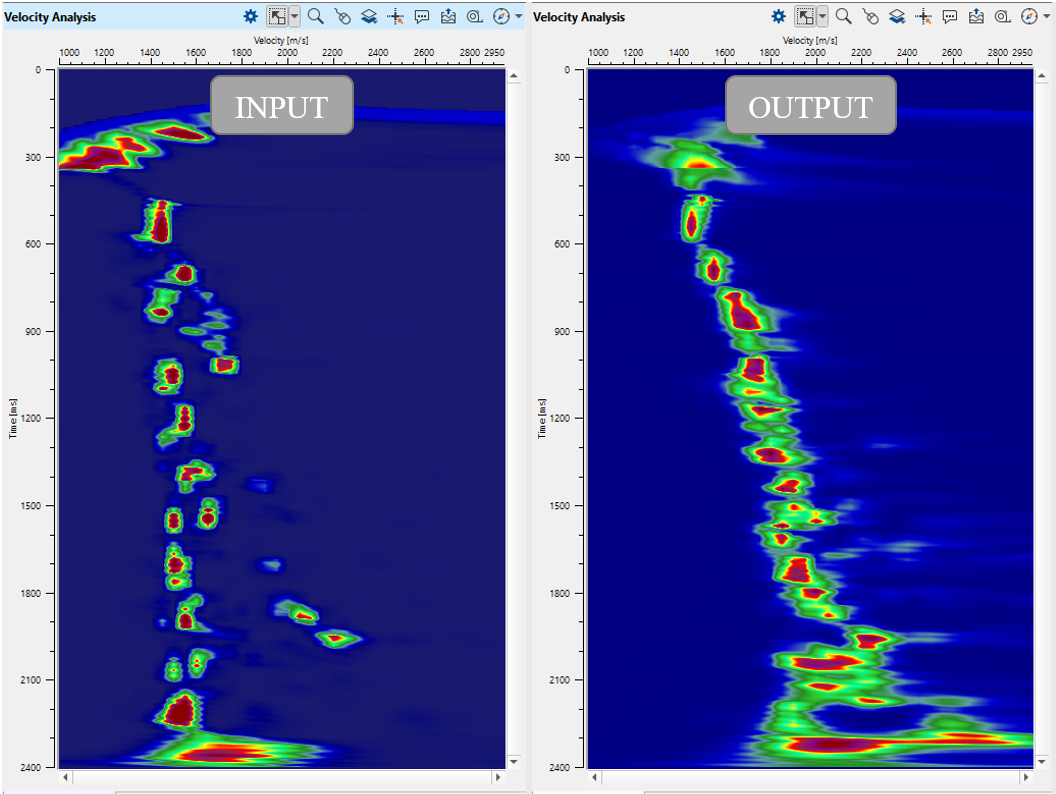
Velocity spectrum before multiple attenuation (left) and after (right).