Seismic attributes 2D
Generate various seismic attributes
Theory
Seismic attributes gives valuable information in the reflection seismology as well as reservoir studies. The main seismic attributes in the reflection seismology are
- Amplitude
- Frequency
- Phase
Besides these attributes there are many attributes that can be generated using the seismic data or for that matter seismic trace and analyze their properties which will be helpful in understanding the physical properties of the wave propagation, attenuation etc. These attribute information is useful in better understanding of the structural and stratigraphic interpretation of the geological events. From these attributes we can measure
What is the minimum & maximum amplitude of a particular trace or a cube?
What is the minimum & maximum frequency of the seismic volume? etc.
Some of the seismic attributes calculated in g-Platform.
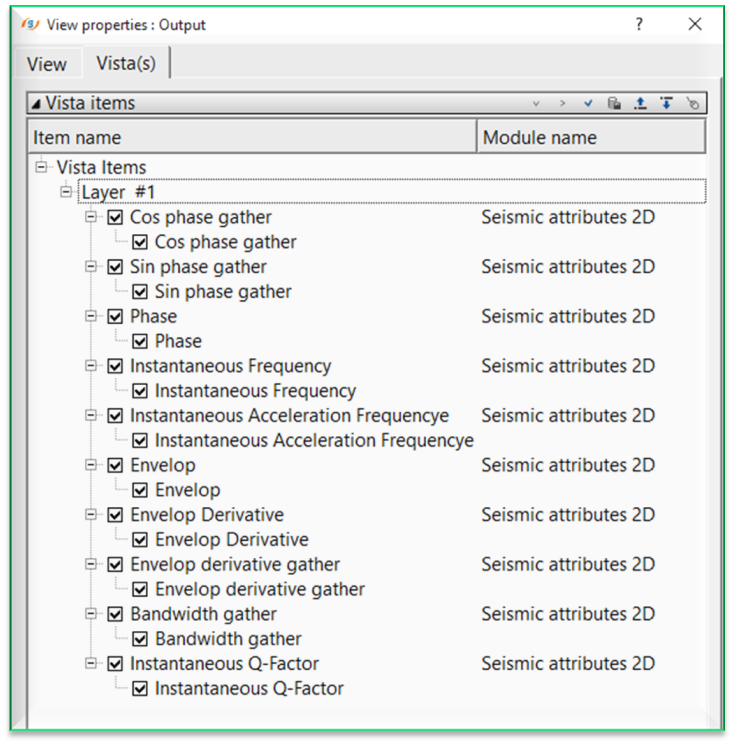
We give a brief explanation about each one of them below.
- Cos phase gather - is a prestack seismic property that is calculated by projecting the result onto the cosine of the instantaneous phase after formalizing each trace in a gather by its instantaneous amplitude.
It is a phase-based, amplitude-independent feature intended to improve reflector continuity and reduce amplitude fluctuations across offsets.
Typical Cos phase ranges from -1 to +1
- Sin phase gather - Sin Phase Gather (prestack data) is produced by projecting each trace's normalized analytic signal onto the instantaneous phase's sine.
After amplitude normalization, it displays the seismic signal's imaginary component.
Similar to Cos Phase Gather, it highlights the component that is 90° out of phase with the original trace while eliminating amplitude effects and maintaining waveform geometry. Typical Sin phase ranges from -1 to +1
- Phase - Phase is the instantaneous phase of the seismic trace that is obtained from the signal analysis.
It describes the seismic waveform's angular position at each time sample, regardless of its amplitude.
Because phase emphasizes reflector geometry rather than reflection strength, it is one of the most effective characteristics for structural and stratigraphic interpretation. Typical phase ranges from -π to +π
- Instantaneous frequency - Instantaneous Frequency is a seismic attribute that measures the rate of change of instantaneous phase with time at each sample of a seismic trace.
It describes how fast the seismic waveform oscillates locally and provides insight into Bed thickness, attenuation effects, fluid related frequency anomalies.
It is derived from the analytic signal using complex trace analysis. It displays the thin beds much better since it doesn’t consider the bright spots, lower or higher amplitudes etc.
Typical range is the bandwidth of the input seismic data.
- Instantaneous Acceleration frequency - it is a higher-order seismic attribute defined as the second time derivative of instantaneous phase (or equivalently, the first derivative of instantaneous frequency).
It measures how rapidly the instantaneous frequency itself is changing with time.
While instantaneous frequency tells us how fast the waveform oscillates, instantaneous acceleration frequency tells us “How quickly that oscillation rate is changing”
It is a highly sensitive attribute used for detecting thin beds, rapid lithological transitions, and subtle stratigraphic features.
- Envelop - it is also known as Instantaneous Amplitude, is one of the most widely used seismic attributes. It represents the total reflection strength at each time sample, independent of waveform phase. In other words, the envelop tells us how strong the seismic reflection is, regardless of polarity or phase.
It is used for identifying bright spots, identifying thin beds etc.
- Envelop Derivative - it is the time derivative of the envelope or instantaneous amplitude. If the envelope measures how strong the seismic signal is, then the envelope derivative measures “How rapidly the reflection strength is changing with time”
It highlights sharp transitions in reflectivity.
- Envelop Derivative gather - it is obtained by computing the envelope derivative trace-by-trace in a prestack gather (CMP, shot, offset, or angle gather). Instead of a single stacked trace, we preserve the offset dimension.
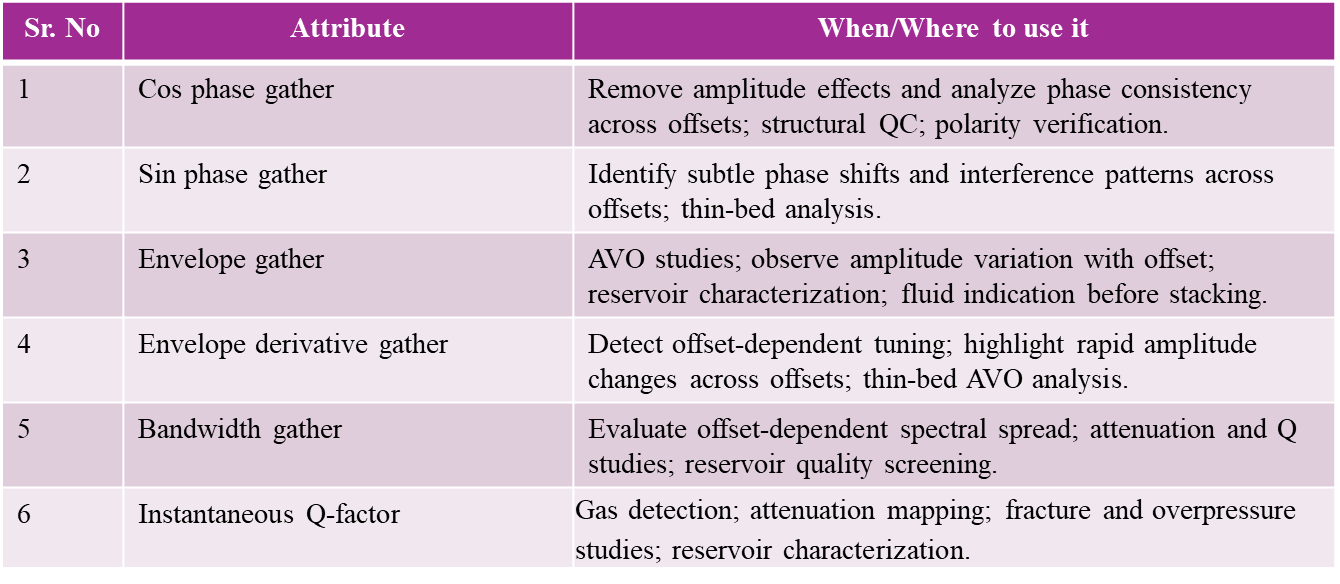
Envelope derivative is used for poststack data(for thin bed mapping, sharp reflector enhancements etc) whereas Envelope derivative gather is used for prestack data (for AVO QC, advanced reservoir studies etc).
- Bandwidth gather - is a prestack seismic attribute that measures the instantaneous frequency spread (spectral width) of each trace within a gather. While instantaneous frequency tells you the center frequency, bandwidth tells us “How wide the frequency content is around that center frequency”?
It is primarily used in prestack analysis for attenuation studies, thin-bed detection, and reservoir characterization.
- Instantaneous Q-factor - is a seismic attenuation attribute that estimates the local quality factor (Q) of the subsurface at each time sample. It measures how rapidly seismic energy loses amplitude and high frequencies as it propagates through the earth.
Out of these 10 attributes, some of them are prestack data and some of them for poststack data.
Prestack data attributes
Poststack data attributes
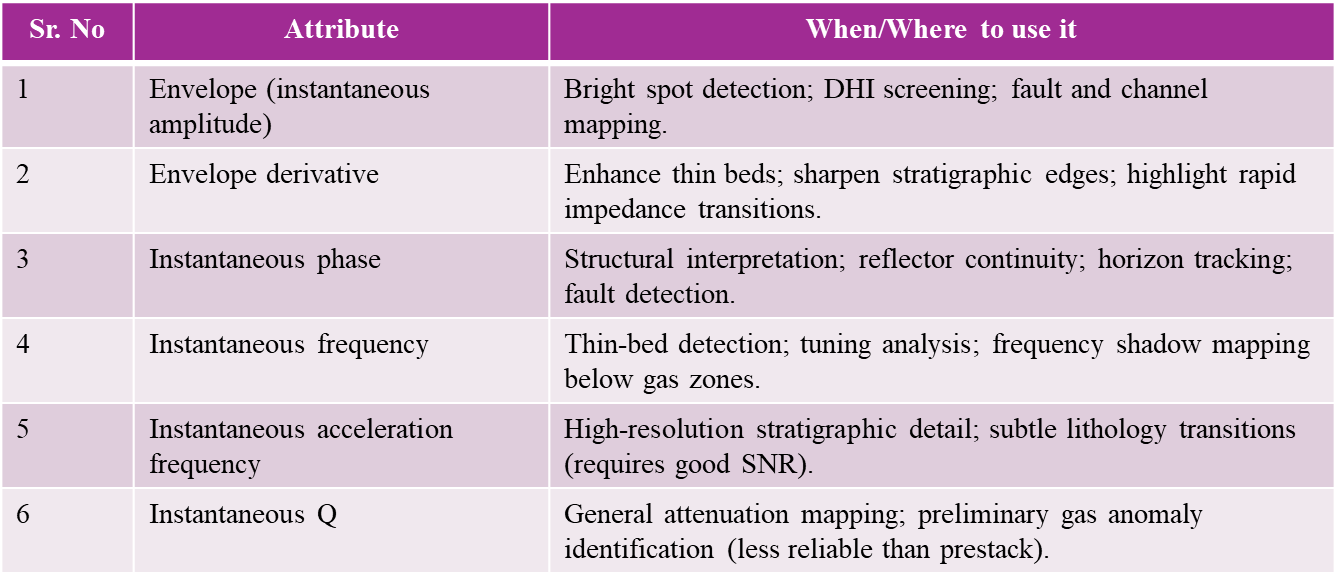
User Recommendation:
Once the user connects the input gathers, then using the Vista Groups you can find out the various attributes information.
Input data
Input gather
this can be a prestack or poststack gather. For prestack data, the user can calculate the attributes of source, receiver, bin gathers. For poststack volume, it calculates the attributes for the entire volume. Connect/reference to Output gather.
Parameters
There are no parameters available for this module.
Settings
Skip
By default, FALSE(Unchecked). This option helps to bypass the module from the workflow.
Output data
Cos phase gather
outputs normalized in-phase structural component.
Sin phase gather
outputs normalized quadrature phase component.
Phase
outputs amplitude-independent reflector continuity.
Instantaneous Frequency
outputs local waveform oscillation rate.
Instantaneous Acceleration Frequency
outputs rapid frequency change detector.
Envelop
outputs reflection strength independent of polarity.
Envelop Derivative
outputs rapid amplitude change indicator.
Envelop derivative gather
outputs offset-dependent amplitude variation changes.
Bandwidth gather
outputs spectral width across offsets.
Instantaneous Q-Factor
outputs local seismic attenuation estimate.
Information
There is no information available for this module.
Examples
In this example workflow, we are generating attributes for both pre and poststack data. For attribute analysis, it is always better to have a good clean input data.
There shouldn't be any sorting required this for this module, however, the input data should be read into memory.
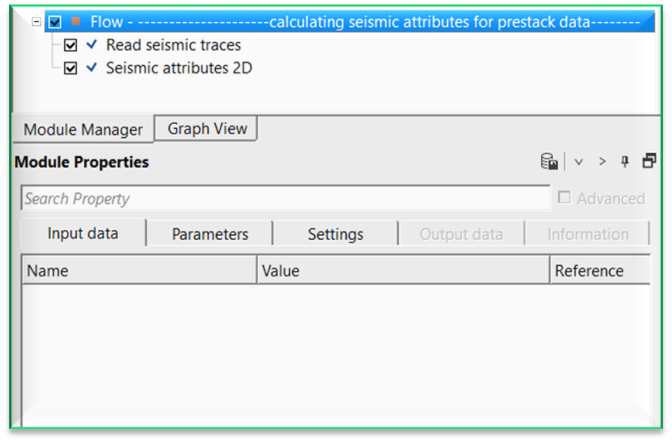
Make the necessary connections/reference.
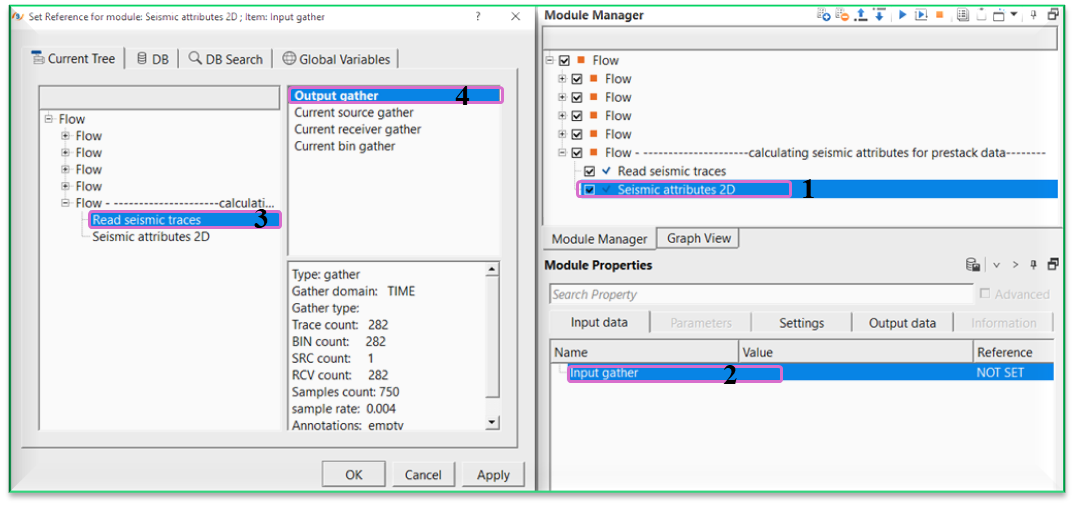
Execute the module and it will generate an output display vista item. In the Output vista item, click on View properties. Now check/uncheck the required seismic attributes.
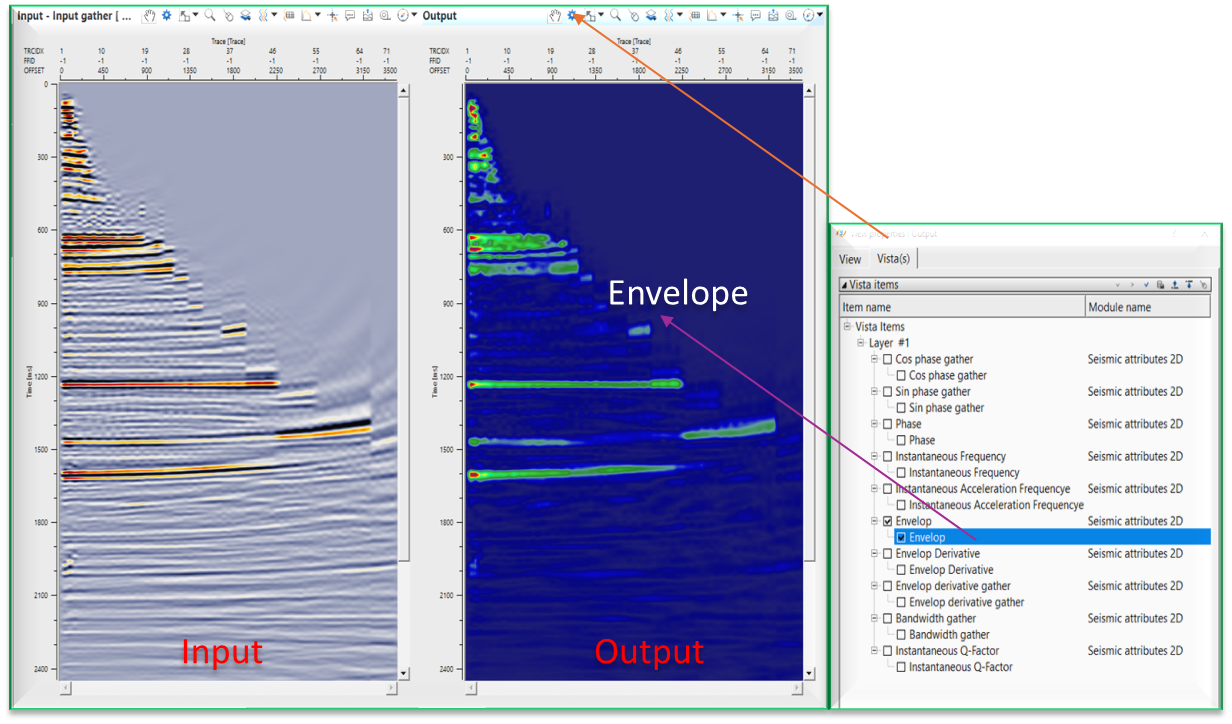
Actions
There are no action items available for this module.
Video lesson
YouTube video lesson, click here to open [VIDEO IN PROCESS...]
Related articles
Yilmaz. O., 1987, Seismic data processing: Society of Exploration Geophysicist
 * * * If you have any questions, please send an e-mail to: support@geomage.com * * *
