Get gather by trace headers
Getting the gather by the trace headers.
Theory
Get gather by trace headers module is very useful to get/display the gathers by using trace headers information. Often times, displaying the gathers is important for QC purpose. Instead of loading the entire line or all gathers, it is advisable to use this module to display selected gathers.
The module reads seismic trace data directly from the data handler using a list of trace headers provided by an upstream module — most commonly the Select traces module. Only the traces whose headers are referenced are loaded from disk, making this an efficient way to inspect specific gathers without processing the full dataset. The resulting output gather can be passed to downstream modules for further analysis or to migration aperture tests.
Once execution is complete, the module also populates a location map display showing the CMP, source, and receiver positions of all loaded traces, giving an immediate spatial QC of which traces were retrieved.
Input data
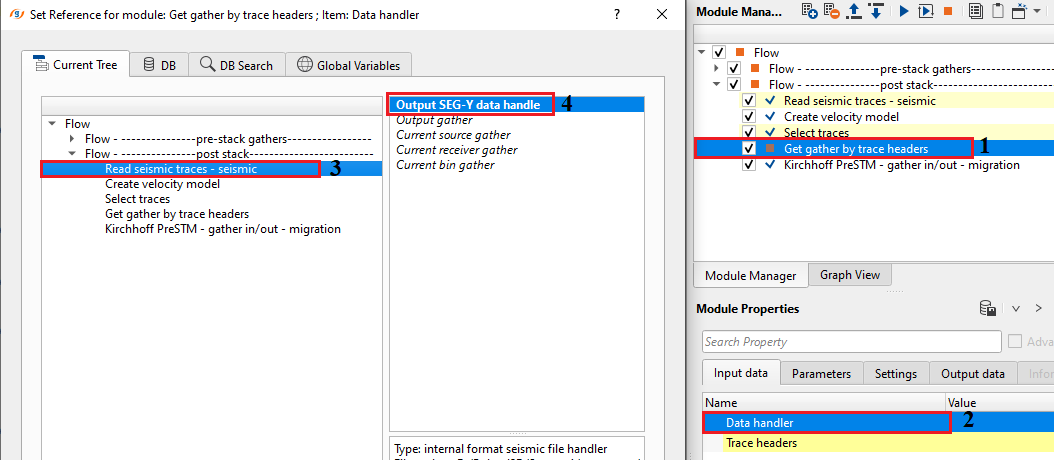
Data handler
connect/reference to the output data handler.
Connect this input to the Data handler output of a data-reading module such as Read seismic traces. The data handler provides a file pointer to the seismic data on disk. When the module executes, it uses this file pointer to read only the traces identified by the connected trace headers, rather than loading the entire dataset into memory. The domain (time, depth, or frequency) is detected automatically from the data handler and reflected in the Gather domain display field.
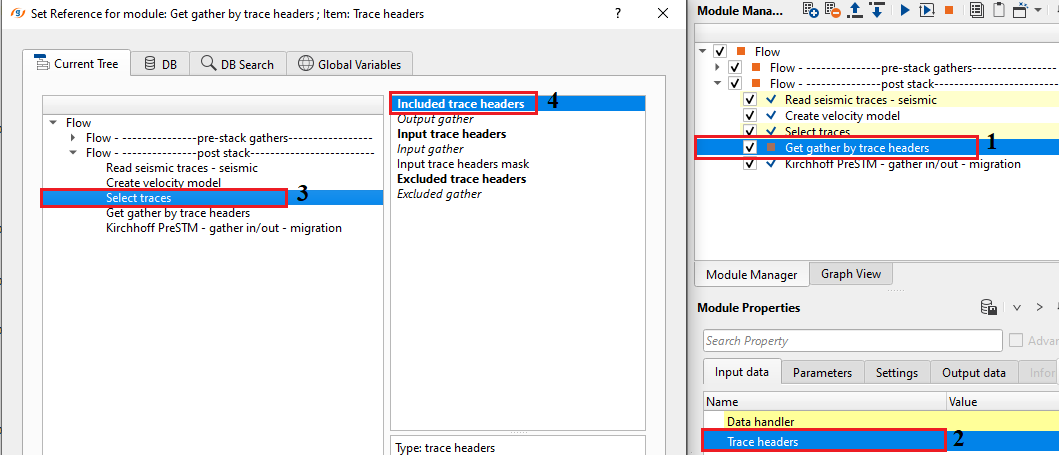
Trace headers
connect/reference to output trace headers of Select traces module. This could be included/excluded traces depending on the selection.
Connect this input to the Included traces (or Excluded traces) output of a Select traces module. The trace header list specifies exactly which traces to retrieve from the data handler. The list must not be empty — if no trace headers are available (for example, because the selection criteria matched nothing), the module will report an error and will not produce output. You can pass included or excluded trace sets depending on which subset you wish to visualize.
Parameters
Gather domain { TIME, DEPTH, FREQUENCY }
select the gather domain from the drop down menu. By default, TIME.
This field displays the domain of the seismic data connected through the Data handler input. It is set automatically by the module upon execution and cannot be changed manually — it always reflects the actual domain of the source data. The three possible values are:
TIME — traces are in the time domain (standard pre-stack or post-stack data, with samples in milliseconds).
DEPTH — traces are in the depth domain (depth-migrated data, with samples in metres).
FREQUENCY — traces are in the frequency domain (amplitude or phase spectra, with samples in Hz).
Settings
Skip
By default, FALSE(Unchecked). This option helps to bypass the module from the workflow.
When checked (TRUE), the module is disabled and passes no data to downstream connections. Use this to temporarily remove the gather retrieval step from a workflow without deleting the module and its configured connections. By default this is unchecked (FALSE), meaning the module is active and will read and output the gather on every execution.
Output data
Output gather
displays the output gather. This output gather can be used as a output gather item to make connections/references to the subsequent modules within the workflow.
The output gather contains all the traces retrieved from the seismic data file based on the connected trace header list. It can be opened directly in a gather viewer for visual QC, or connected to downstream modules — for example, as the input gather to a migration aperture test. The gather preserves all original trace headers and amplitudes exactly as stored on disk; no processing is applied during retrieval.
Information
This module has no configurable settings panel. All behaviour is governed by the data connected to its input items (Data handler and Trace headers). No additional configuration is required beyond establishing those connections.
Examples
In this example workflow(s), we are discussing how to use Get gather by trace headers when reading pre & post stack data.
Pre-stack data:
In this example, we read the shot ordered gathers. From this, we select 3 consecutive FFID's by using Select traces module. Later, we connect/reference the Included traces of Select traces module to Trace headers of Get gather by trace headers module. The output from Get gather by trace headers module displays all 3 FFIDs in a single display along with the location map.
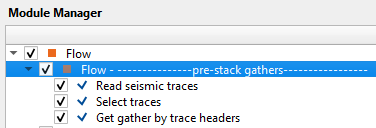
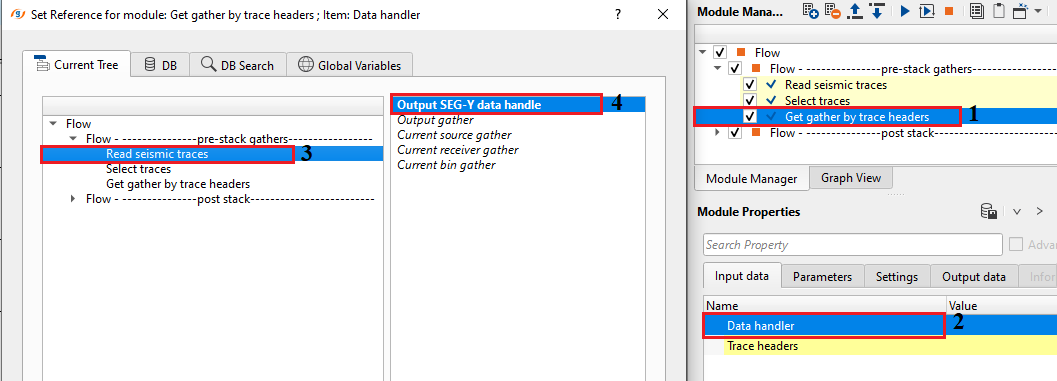
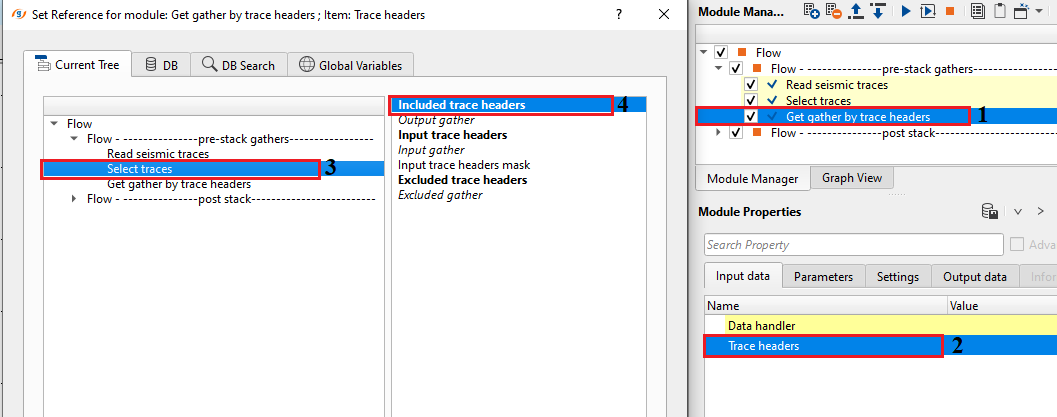
After making the necessary connections/references, launch the Vista items of Get gather by trace headers module. It will displays the Gather along with the location map.
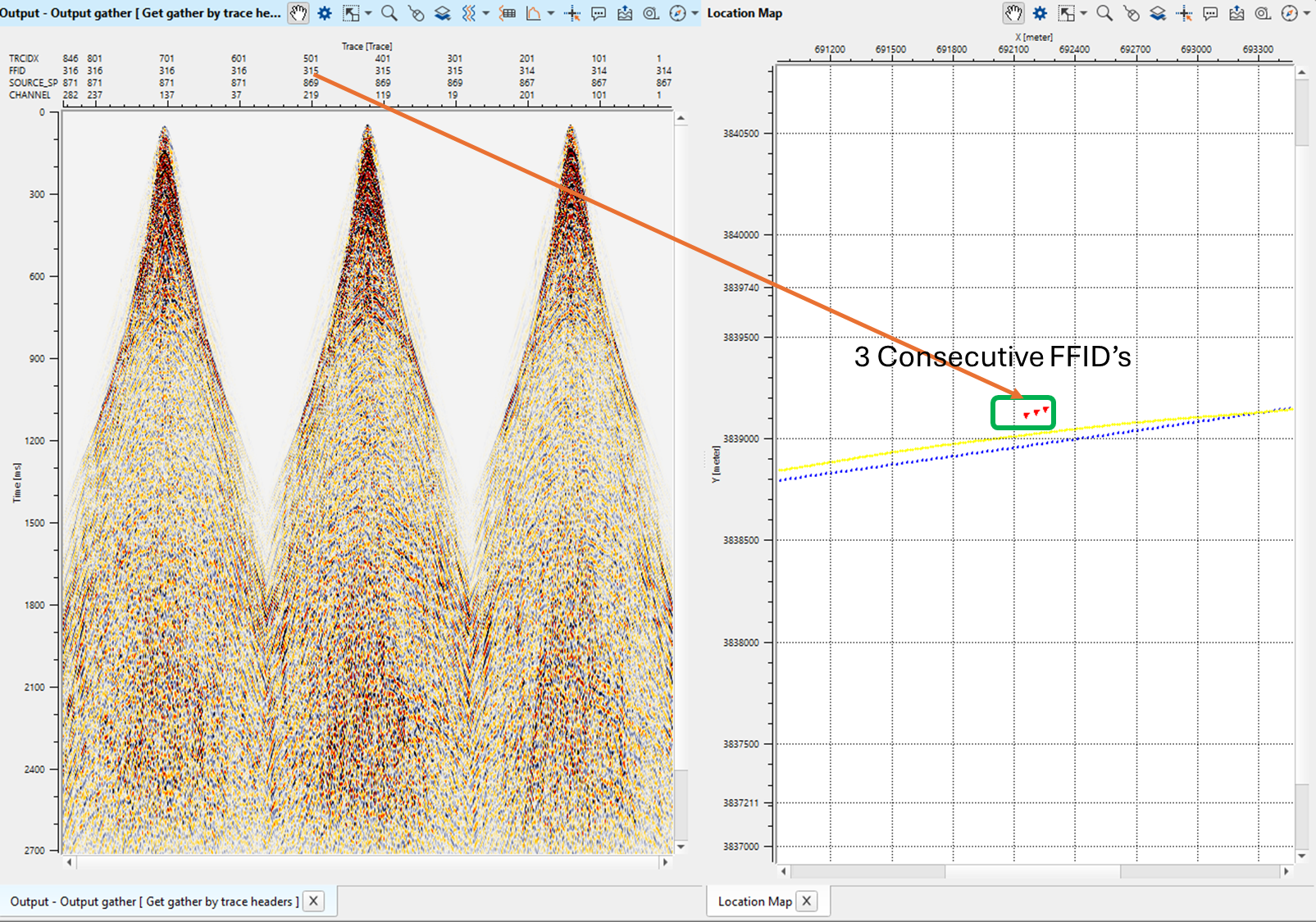
Post-Stack Data:
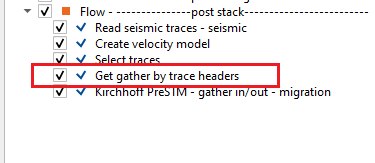
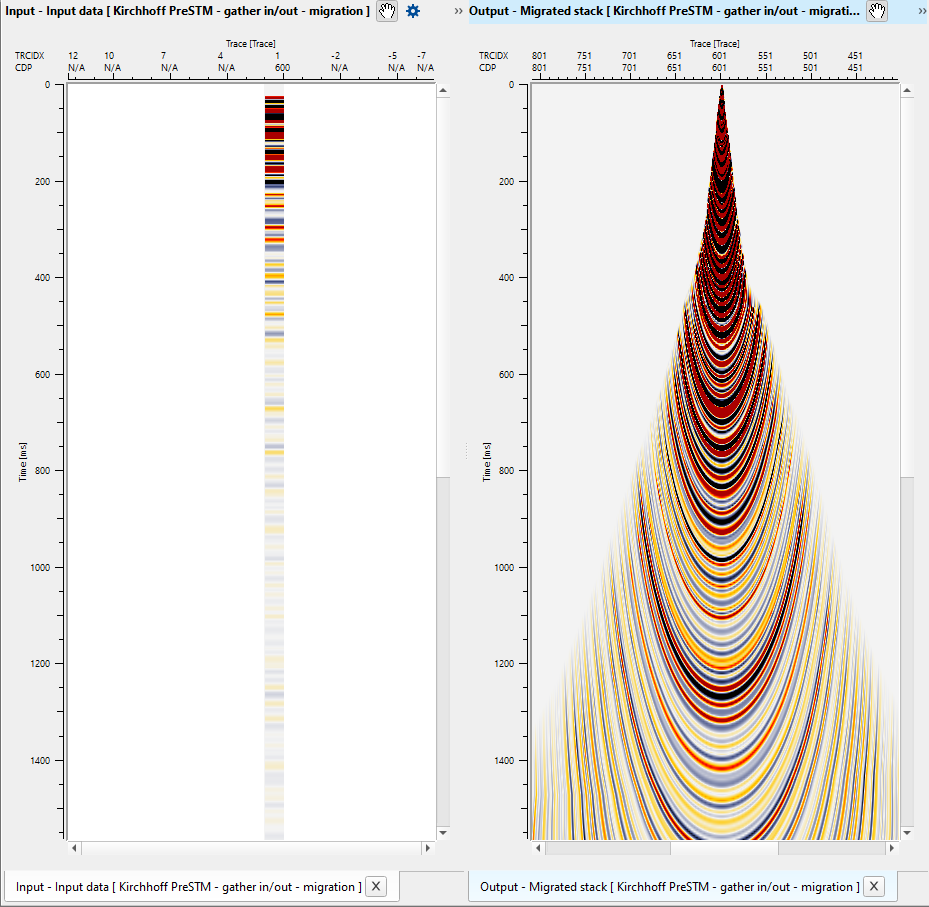
In this workflow, select any single CDP from a stack section and get the gather using Get gather by trace headers. We use output CDP trace/gather for migration aperture test.
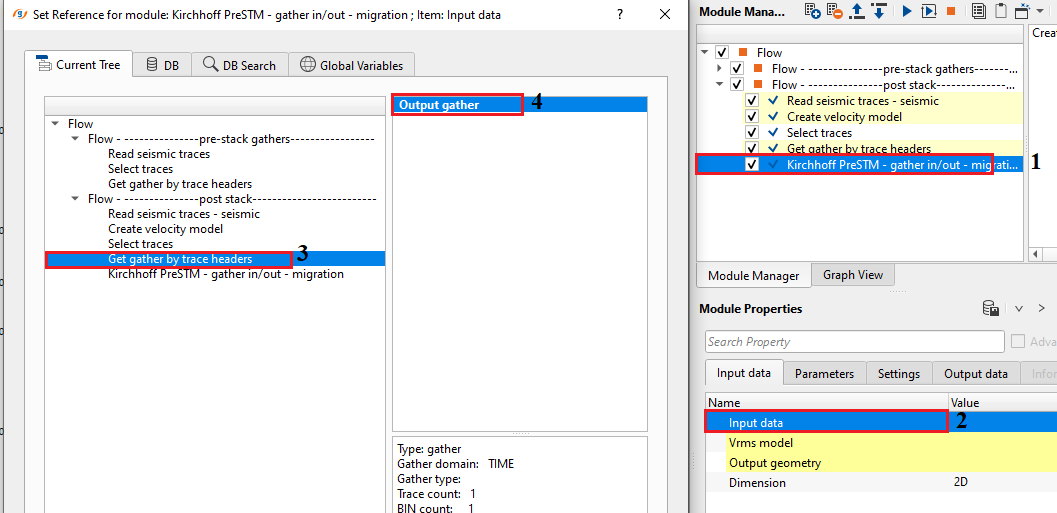
Output geometry should be connect/referenced to Output trace headers of "Read seismic traces".
Actions
There are no action items available for this module so the user can ignore it.
Video lesson
YouTube video lesson, click here to open [VIDEO IN PROCESS...]
Related articles
Yilmaz. O., 1987, Seismic data processing: Society of Exploration Geophysicist
 * * * If you have any questions, please send an e-mail to: support@geomage.com * * *