Crop
Modifying/Cropping of the gather
Theory
The Crop module trims or extends seismic gathers along the time (or depth or frequency) axis and along the trace axis. Use it to reduce the data volume when the zone of interest is shallower than the full record length, to remove unwanted traces from a gather, or to pad a gather to a longer record length before a transform such as Tau-P. Cropping shortens execution time for all downstream modules and reduces disk space requirements for intermediate and final output files.
The module operates on one gather at a time and supports multi-threaded execution. Time trimming and trace selection are applied simultaneously. When the requested output window extends beyond the original record length, the extra samples are filled with the constant value specified by the Extended value parameter. An optional linear taper is then applied to both ends of every trace to suppress edge effects.
Input data
Input DataItem
Input gather
connect/reference to the Output gather. In case, Crop module is inside the Seismic loop, it automatically connect/reference the previous module Output gather as Input gather to Crop module.
Parameters
Time start
specify the starting time for the gather modification
The first sample of the output gather, expressed in seconds (time domain), meters (depth domain), or Hz (frequency domain). The default value of -0.001 is a sentinel that means "start from the beginning of the input gather" — the module preserves the original start position. Set a positive value to discard shallow (early-time) data. The label changes automatically to Depth start or Frequency start when the gather domain changes.
Time end
specify the end time for the gather modification
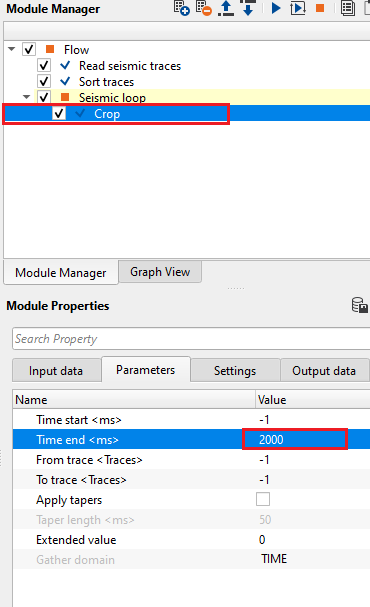
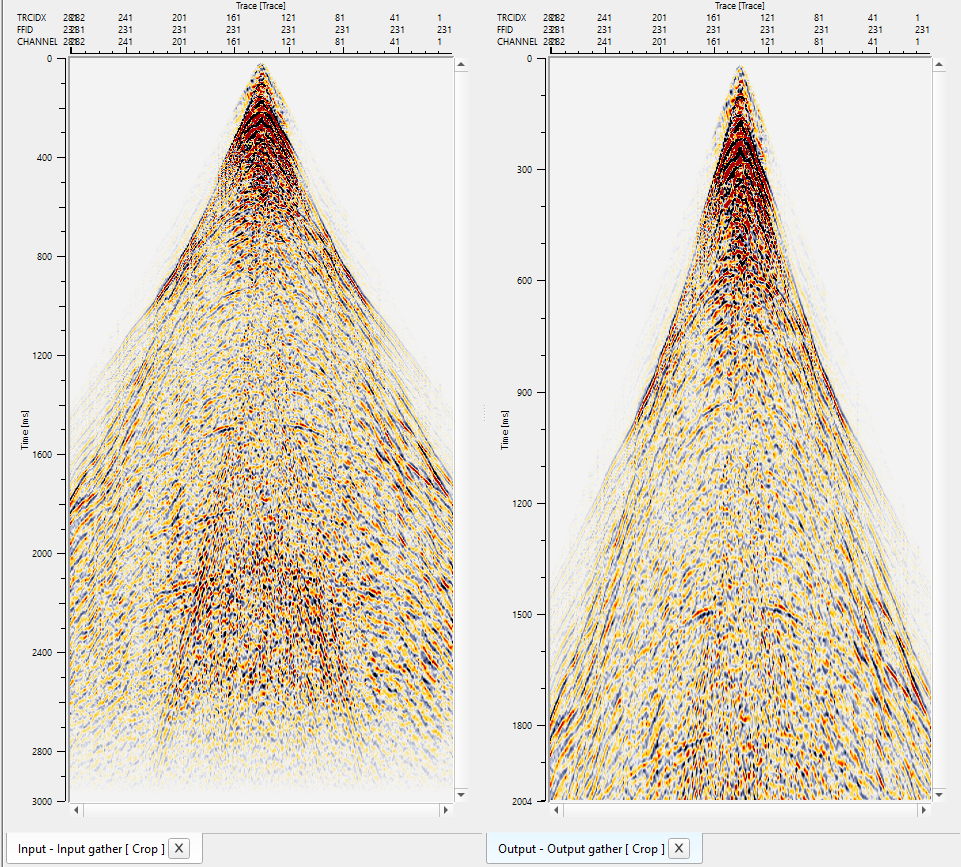
The last sample of the output gather, in the same units as Time start. The default value of -0.001 means "use the full length of the input gather." Set this to a time shallower than the original record length to trim the data. To extend the gather beyond its original length, set Time end to a value greater than the original record end; new samples will be filled with the Extended value. Time end must always be greater than or equal to Time start; otherwise the module will report an error.
From trace
in case of trace modification, specify the starting trace (sequence number)
The sequence number (1-based) of the first trace to retain in the output gather. The default value of -1 means "start from the first trace." Use this parameter together with To trace to select a contiguous subset of traces from a shot or CMP gather, discarding all traces outside the range.
To trace
specify the end/last trace(sequence number) for trace modification
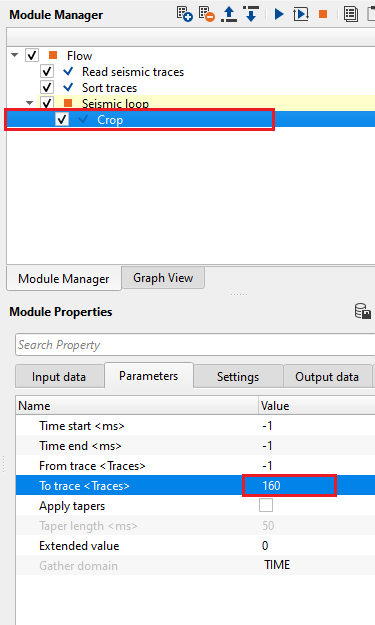
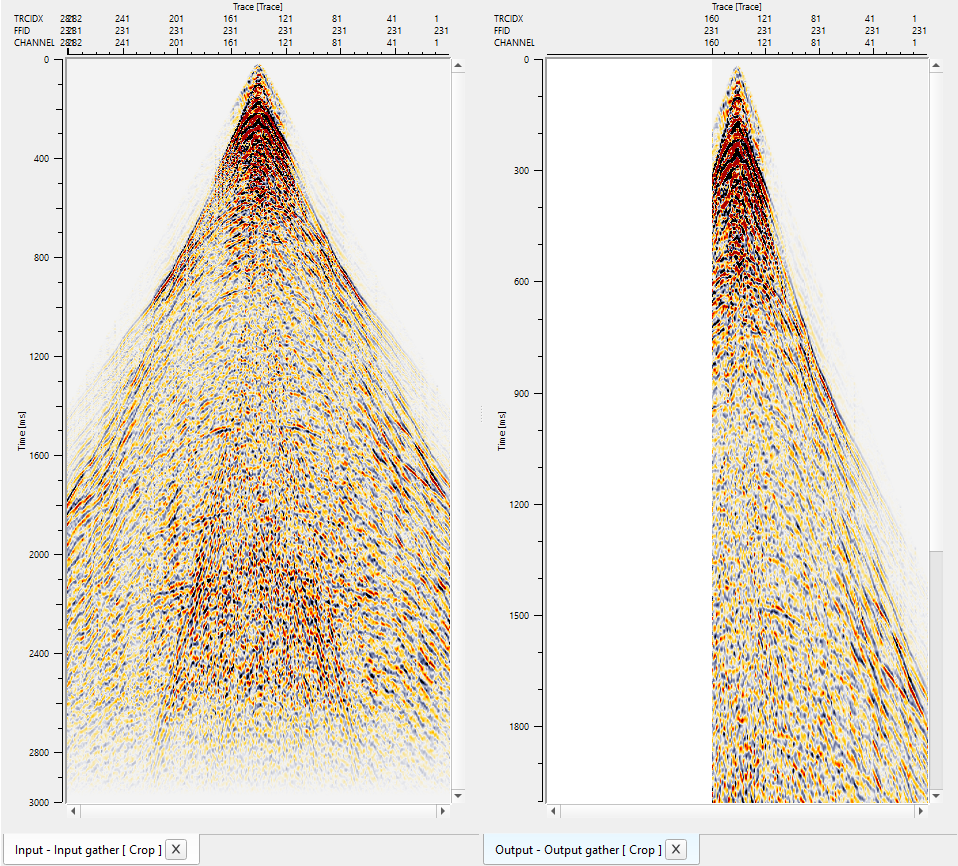
The sequence number (1-based) of the last trace to retain in the output gather. The default value of -1 means "keep all traces through the last trace." To trace must be greater than or equal to From trace; if To trace exceeds the total number of traces in the gather it is silently clamped to the last available trace.
Apply tapers
tapers are applied for smoothing transitioning at the boundaries to avoid any edge effects.
When enabled (default: false), a linear amplitude ramp is applied symmetrically to both the start and end of every output trace. The ramp smoothly scales amplitudes from zero at the cut boundary up to full amplitude over the taper zone, eliminating the sharp discontinuities that would otherwise cause spectral leakage or ringing in subsequent frequency-domain processes. Enable this option when the cropped gather will be input to a Tau-P transform, FK filter, or any frequency-domain analysis. Enabling this option reveals the Taper length sub-parameter.
ApplyTapers - true
If Taper application is TRUE, it will apply the tapers
Taper length
taper length helps to avoid edge/boundary effects when cropping/modifying the data.
The length of the linear taper zone applied at both the start and the end of each output trace, expressed in seconds (or meters in depth domain). Default: 0.05 s (50 ms). Minimum value: 0 (no taper). If the specified taper length exceeds half the output trace length, it is automatically clamped to half the trace length to prevent the two ramps from overlapping. A taper of 50–100 ms is sufficient for most band-limited seismic data; increase the value if the dominant frequency is very low (long wavelength).
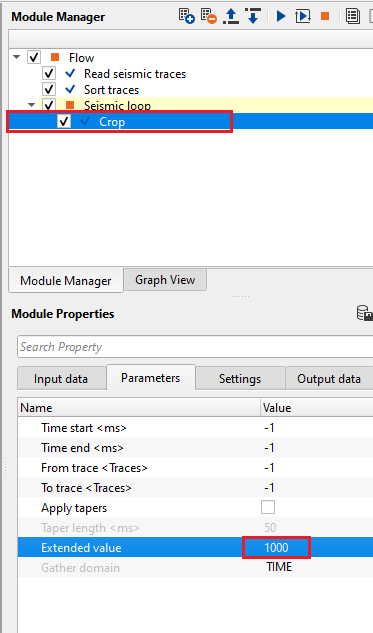
Extended value
this parameter extends the output gather length.
The constant amplitude value used to fill samples in the output gather that lie beyond the end of the original input record. Default: 0. This parameter is relevant only when the requested Time end exceeds the original record length, extending the gather. In most seismic processing workflows, zero-padding is appropriate (default value of 0). A non-zero fill may be used in special modeling or synthetic scenarios.
Gather domain { TIME, DEPTH, FREQUENCY }
specify the gather domain from the drop down menu.
Indicates the vertical axis units of the gather connected to the input. This field is read-only — it is set automatically based on the domain reported by the input gather and cannot be changed manually. The default is TIME. When the domain is TIME, Time start and Time end are in seconds; when DEPTH, they are in meters; when FREQUENCY, they are in Hz.
Time domain - works with the time domain
Depth domain - works with the depth domain
Frequency domain - works with the frequency domain data
Settings
Auto-connection
By default, TRUE(Checked).It will automatically connects to the next module. To avoid auto-connect, the user should uncheck this option.
Bad data values option { Fix, Notify, Continue }
This is applicable whenever there is a bad value or NaN (Not a Number) in the data.By default, Notify. While testing, it is good to opt as Notify option. Once we understand the root cause of it, the user can either choose the option Fix or Continue. In this way, the job won't stop/fail during the production.
Notify
It will notify the issue if there are any bad values or NaN. This is halt the workflow execution.
Fix
It will fix the bad values and continue executing the workflow.
Number of threads
One less than total no of nodes/threads to execute a job in multi-thread mode. Limit number of threads on main machine.
Skip
By default, FALSE(Unchecked). This option helps to bypass the module from the workflow.
Output data
Output DataItem
Output gather
generates the modified/cropped output gather.
Information
There is no information available for this module so the user can ignore it.
Examples
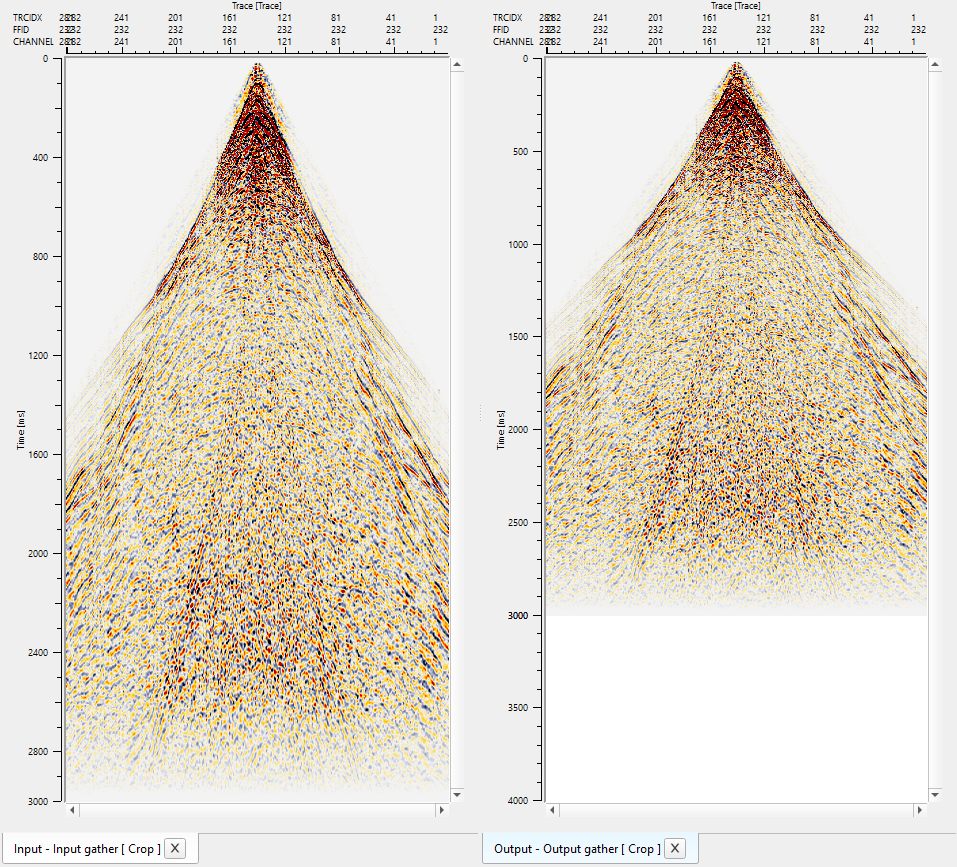
In this example workflow,
- CROP module modifying/cropping of a shot gather by reducing the output length.
- Selecting traces from the user defined ranges
- Extending the record length for processes like Tau-P etc.
Actions
There are no action items available for this module so the user can ignore it.
Video lesson
YouTube video lesson, click here to open [VIDEO IN PROCESS...]
Related articles
Yilmaz. O., 1987, Seismic data processing: Society of Exploration Geophysicist
 * * * If you have any questions, please send an e-mail to: support@geomage.com * * *