Editing/Adding text/EBCDIC header information


This module helps to edit or assign the text header/EBCDIC header information. Text header information is very useful for the interpreters and/or the processing contractors to go through the processing history of the dataset(s). In the Text header, all the processing history, acquisition parameters, grid information etc. included.
Every SEG-Y file contains a mandatory 3200-byte text header stored as the very first block of the file. This header is encoded in EBCDIC format and consists of exactly 40 lines of 80 characters each. Although invisible to most applications, it is the standard place to record the seismic survey name, acquisition parameters, processing sequence, coordinate system, binary header byte locations, and any other metadata the processing team considers important. The EBCDIC editor module reads that header from either a SEG-Y file or a plain-text file, lets you edit it, and writes the updated header back into the SEG-Y file in place — without disturbing any trace data.
Use this module when you need to update or correct the text header on an existing SEG-Y dataset — for example, after completing a processing sequence, before delivering data to a client, or when the original header is missing or incorrect. The module also supports template-style substitution: you can embed workflow variable names inside the header text using the %variable% or $variable$ syntax, and g-Platform will automatically replace them with the current global or local workflow variable values at execution time.

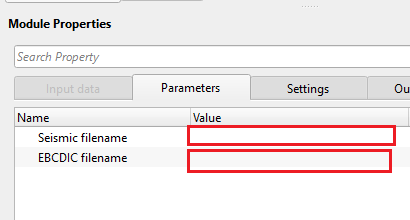
Input data tab is disabled for this module. The user must provide all the input data information in the parameters tab.

Seismic filename - provide the input seismic/SEGY file path.
Provide the full path to the SEG-Y file whose text header you want to update. Accepted formats are .sgy and .segy. The file must already exist on disk. When the module executes, it opens this file, converts the edited text header from ASCII to EBCDIC encoding, and overwrites the first 3200 bytes (40 lines x 80 characters) of the file. The rest of the file — binary header, extended text headers, and all trace data — is left completely unchanged.
EBCDIC filename - provide the input text header/EBCDIC header file path.
Provide the path to a plain-text file containing the new text header content. Accepted formats are .txt, .csv, and .ebcdic. The file should contain up to 40 lines; any additional lines beyond the 40th are silently discarded. Each line is automatically padded with spaces to exactly 80 characters, or truncated if longer. If you have used the Set text header from buffer custom action to paste header text directly into the module, this field is optional — the buffer content takes priority over the file path.

Skip -By default, FALSE(Unchecked). This option helps to bypass the module from the workflow.
When checked, the module is skipped entirely during workflow execution and no changes are written to the SEG-Y file. Use this option when you want to temporarily disable text header editing without removing the module from your workflow chain. Default: unchecked (the module runs normally).

Table Text Header - generates the output text/EBCDIC header.
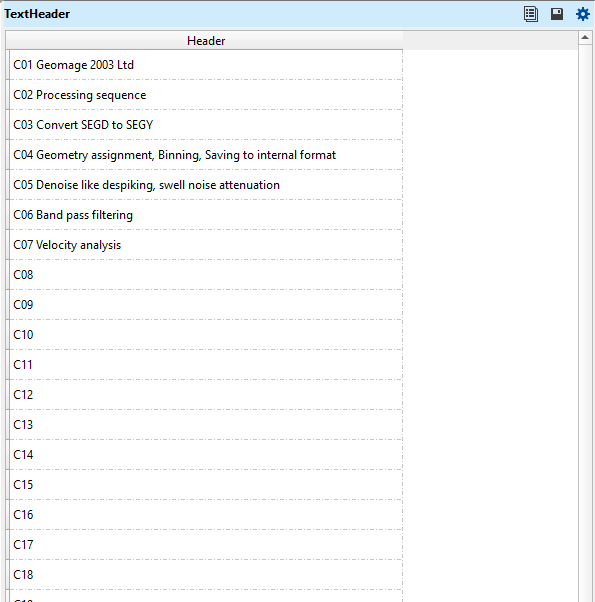
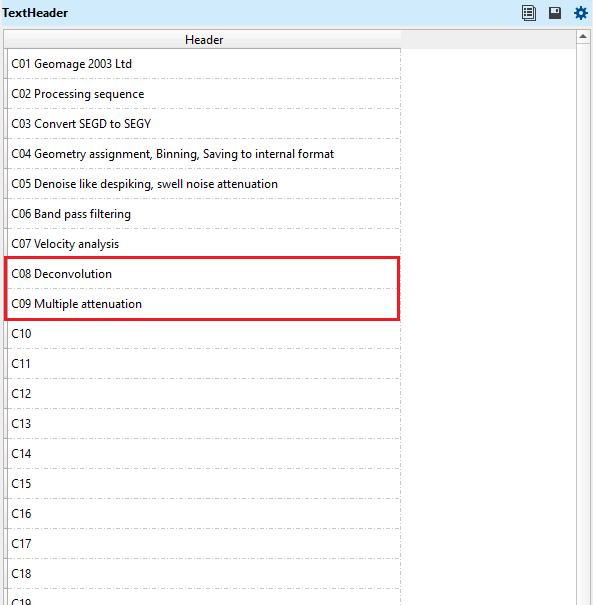
This output vista item displays the text header content as a table with one column (Header) and 40 rows — one row per text header line. Open this vista item to preview the exact content that will be written to the SEG-Y file, both before and after execution. Use it to verify that all 40 lines appear correctly, that line lengths are within the 80-character limit, and that any workflow variables have been substituted with their expected values. The table is refreshed automatically each time you run the module or invoke a custom action.

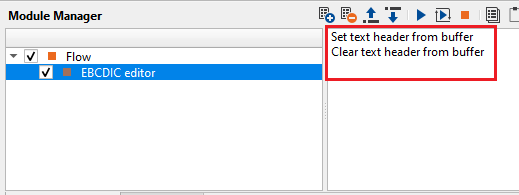
The EBCDIC editor provides two custom actions that let you supply and manage text header content directly within the g-Platform interface, without requiring an external file.

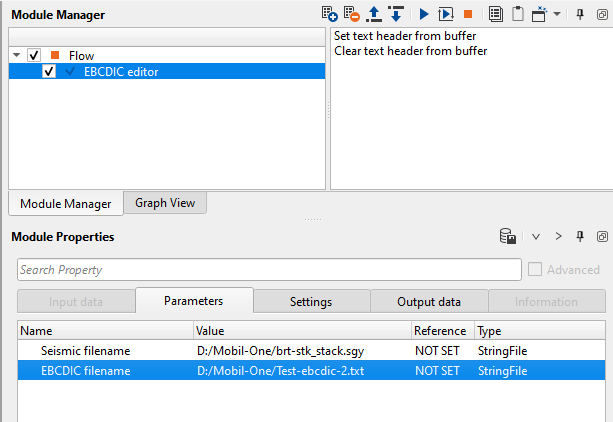
In this example workflow, we provide the seismic and text/EBCDIC header files path. Later, we change the text/EBCDIC header information by using the action items ""Set text header from buffer".
Launch vista items "Text header". It will display the current Text/EBCDIC header information.
To edit/add anything to this existing Text/EBCDIC header, click on "Set text header from buffer" option from the action items menu.
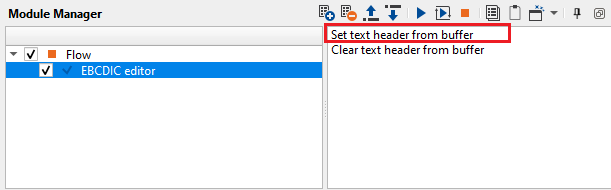
A pop-up window opens with a caption "Please, paste text header here...". Prior to that, the user should copy the existing Text/EBCDIC header by opening it with any text editor. This copied text/EBCDIC header information should be pasted inside the Text header from buffer window.
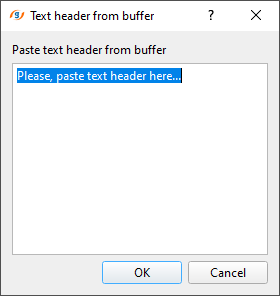
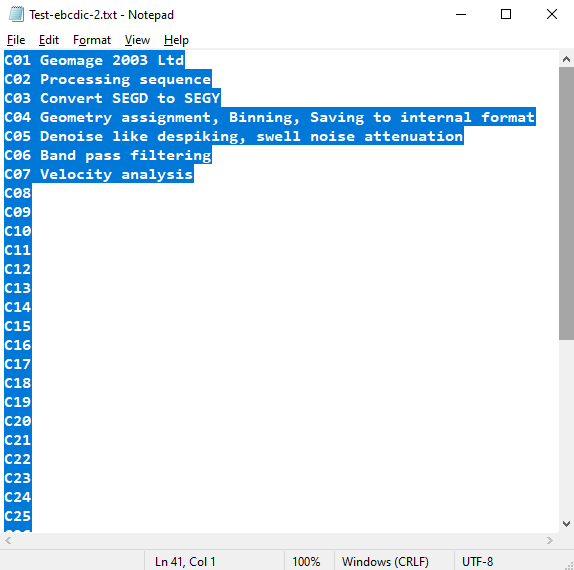
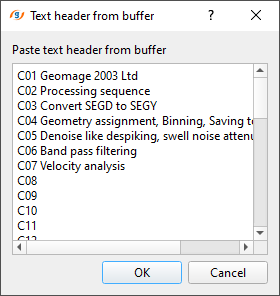
Now add or edit the text/EBCDIC header information within the Text header from buffer window and click OK.
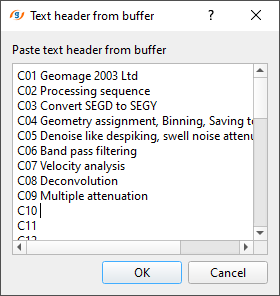
After editing/adding additional information, execute the module EBCDIC editor module and check the Text header vista item.


Set text header from buffer - This allows the user to add/edit text header information. The user must copy the previous text header information and paste it inside the pop-up window. Once it is pasted, now edit the text inside the pop-up window. Now execute the EBCDIC editor module to see the changes by generating the vista items.
Invoking this action opens a multi-line text pop-up with the prompt "Please, paste text header here...". Paste or type the desired header text directly into the pop-up window, then click OK. The pasted content is stored inside the module and replaces the EBCDIC filename path as the source of the header for the next execution. This approach is useful when you do not have a separate header file on disk, or when you want to make quick edits to an existing header without creating a file. After clicking OK, open the Table Text Header vista item to review the result before executing, then run the module to write the updated header to the SEG-Y file.
Clear text header from buffer - this option allows the user to clear the previously copied text header in the pop-up window.
Invoking this action discards any header text that was previously pasted via the Set text header from buffer action. After clearing, the module will revert to reading its header content from the file path specified in the EBCDIC filename parameter. Use this action when you want to switch back to using a header file after having worked with the buffer, or simply to clear any accidentally pasted content before executing.

YouTube video lesson, click here to open [VIDEO IN PROCESS...]

Yilmaz. O., 1987, Seismic data processing: Society of Exploration Geophysicist
 * * * If you have any questions, please send an e-mail to: support@geomage.com * * *