Read ZGY
Reading ZGY file format files to use it inside g-Platform environment.
Theory
ZGY is a proprietary 3D seismic volume format developed by Schlumberger for use in its interpretation platforms such as:
- Petrel
- Studio
- GVERSE/Geoprobe (older support)
- OpendTect (read-only plugins)
It is designed specifically for large 3D seismic datasets, supporting fast access, efficient storage, and smooth visualization.
ZGY stands for:
Z (seismic impedance) + GY (geometry) (an informal historical interpretation — original meaning is not officially public)
Key Features of ZGY Format
1. High-Performance 3D Volume Format
ZGY is optimized for:
- Real-time viewing
- Instant slicing (inline, crossline, arbitrary lines)
- Instant extraction (horizons, time/depth slices)
- Handling massive datasets (100s of GBs to TBs)
It’s far more efficient than SEG-Y for interpretation workflows.
2. Tiled / Bricked Data Storage
ZGY divides the 3D volume into small tiles or bricks, which allows:
- Fast random access
- Only loading needed sub-volumes
- Smooth zoom/pan interaction in Petrel
This is why ZGY scrolls so fluidly compared to SEG-Y.
3. Supports Both Time and Depth Domains
ZGY volumes can store:
- Time (TWT) seismic
- Depth seismic
- Pre-stack attributes
- Post-stack attributes
4. Efficient Compression
Modern ZGY (HDF5-based) supports:
- Lossless compression
- Lossy compression (optional)
- Multi-resolution pyramids (mipmaps)
This dramatically reduces disk space and speeds up display.
5. Metadata Embedded Internally
Unlike SEG-Y, ZGY stores:
- Inline/crossline geometry
- Coordinate reference system (UTM / geographic / custom CRS)
- Vertical sampling (dt / dz)
- Corner points
- Data statistics
- Volume extents
- Units and domain info
Petrel reads this instantly without requiring navigation files.
ZGY Versions
Old ZGY (Legacy ZGY)
- Binary proprietary format
- Petrel pre-2017 versions
- Limited compression
- No HDF5 backend
New ZGY (OpenZGY / HDF5 ZGY)
- Since ~2018
- Built on HDF5
- Open API available (OpenZGY library)
- Supports cloud storage (Azure, AWS)
- Multi-resolution access
ZGY is not a processing format — it is an interpretation and visualization format.
Input data
Input file name
- specify the input data file in ZGY format.
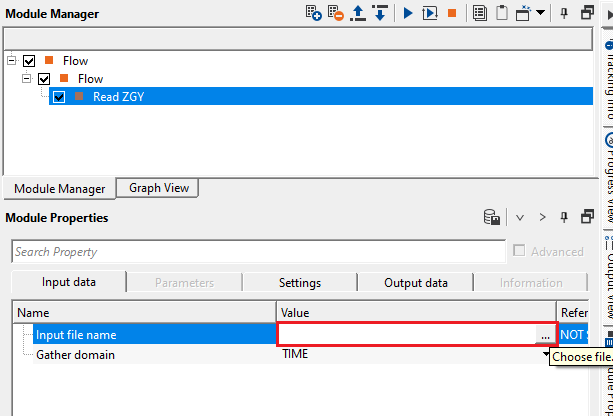
Gather domain { TIME, DEPTH, FREQUENCY } - allows the user to specify the input data domain type. By default, Time. There are additional domain options available from the drop down menu.
Time - Input data is in Time domain
Depth - Input data is in Depth domain
Frequency - Input data is in Frequency domain
Parameters
Parameters tab is disabled. There are any parameters to mention to this module.
Settings
Skip
By default, FALSE(Unchecked). This option helps to bypass the module from the workflow.
Output data
Output DataItem
Output gather
generates the output gather to be used in the g-platform environment.
Information
There is no information available for this module so the user can ignore it.
Examples
Actions
There are no action items available for this module.
Video lesson
YouTube video lesson, click here to open [VIDEO IN PROCESS...]
Related articles
Yilmaz. O., 1987, Seismic data processing: Society of Exploration Geophysicist
 * * * If you have any questions, please send an e-mail to: support@geomage.com * * *
