3D volume radial trace denoise
Description
Modeling coherent noise in the R-T domain
The radial trace transform is a simple transform to map gathers in x-t domain to into an apparent velocity and travel time domain. The apparent frequency of the ground roll will also be transformed in the RT domain. Ground roll can be extracted via the use of filters in the RT domain, to generate a noise model. This noise model can then be adaptively subtracted from your original input data. Results show that this method produces better results than an F-K filter, with less reduction in the amplitude spectrum.
The transform is defined by:
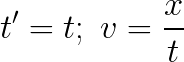
This module is the 3D volume variant of the radial trace denoise workflow. It operates on prestack gathers sorted either by common-shot receiver line or common-receiver source line. For each gather, it computes the forward radial transform, passes the transformed data to the Process on RT transform sub-procedure (which applies the user-defined filter in R-T space), then performs the inverse transform. The difference between the original gather and the reconstructed filtered gather is the noise model. A velocity-cone mute is applied to the noise model so that only energy within the apparent velocity range defined by Min velocity and Max velocity is treated as noise. Three output datasets are produced: the denoised gather, the noise model gather (for quality control), and the forward radial transform gather.
Parameters
Min velocity
The minimum apparent velocity (m/s) of the noise cone. Energy with apparent velocity slower than this value is considered signal and is not included in the noise model. Set this to just below the slowest primary reflections in your data. Typical values for ground roll suppression on land data range from 100 to 400 m/s. Default: 100 m/s. Setting this too high risks attenuating genuine reflections at shallow offsets.
Max velocity
The maximum apparent velocity (m/s) of the noise cone. Only energy with apparent velocity between Min velocity and Max velocity is treated as coherent noise. Samples below the traveltime corresponding to Max velocity at each offset are zeroed in the noise model, protecting primary reflections. Set this to the approximate maximum velocity of the noise you wish to attenuate. Default: 1500 m/s.
Table type
Controls the velocity-axis sampling scheme used when building the radial transform table. Linear — uniform spacing at a fixed velocity increment (controlled by Velocity step). Quadratic (default) — parabolic spacing with finer sampling near zero velocity and coarser sampling at higher velocities, controlled by Velocity min step and Velocity max step. Recommended for most land datasets.
Velocity min step
Active only when Table type is Quadratic. The smallest velocity increment (m/s) used near zero velocity. Finer values improve resolution for slow noise but generate more radial traces. Default: 1 m/s. Must be less than Velocity max step.
Velocity max step
Active only when Table type is Quadratic. The largest velocity increment (m/s) used near maximum velocity. Default: 10 m/s. Must be greater than Velocity min step.
Time coord R-T origin
The time intercept (ms) of the radial transform origin. Shifts the apex of the velocity cones in time. Leave at 0 ms for standard data where noise originates at time zero.
Offset coord R-T origin
The offset origin (m) for the radial transform, subtracted from each trace offset before computing the transform. Default: 0 m. Set a non-zero value only if the noise apex does not occur at zero offset in your survey geometry.
Sorting type
Specifies the gather orientation used to interpret offset directions during the radial transform. CS receiver line (default) — common-shot gathers sorted along receiver lines. CR source line — common-receiver gathers sorted along source lines.
References
Henley, D. C., 2003, Coherent noise attenuation in the radial trace domain: Geophysics, 68, 1408-1416.