Vint time to Vint depth
Interval velocity conversion from Time domain to Depth domain.
Theory
The algorithm for converting interval velocity from the time domain to the depth domain is used to transform seismic wave velocity data, defined in the depth domain, into corresponding time values. It works by using the interval depth and velocity for each layer of the Earth's crust, calculating the time required for seismic waves to travel through those layers.
Input data
Input V time - Input interval velocity (time domain) gather uploaded into RAM.
Parameters
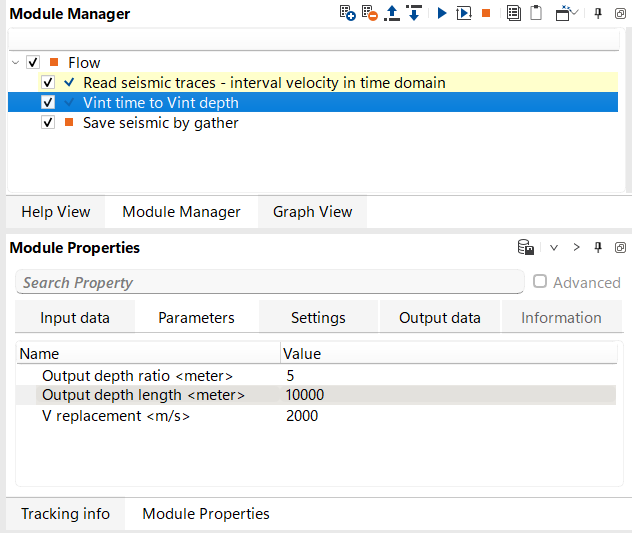
Output depth ratio - define a value of output sample interval / depth interval (for Vint in depth domain).
Output depth length - define a value of output trace length in meters (for Vint in depth domain).
V replacement
velocity replacement in m/s.
Settings
Execute on { CPU, GPU }
select which type of processor will be used for calculations: CPU or GPU.
Distributed execution
if enabled: calculation is on coalition server (distribution mode/parallel calculations).
Bulk size
chunk size is RAM in megabytes that is required for each machine on the server (find this information in the Information, also need to click on action menu button for getting this statistics):
Limit number of threads on nodes
limit numbers of threads on nodes for performing calculations.
Job suffix
add an job suffix.
Set custom affinity
an axillary option to set user defined affinity if necessary.
Affinity
add your affinity to recognize you workflow in the server QC interface.
Number of threads
limit number of threads on main machine.
Run scripts
it is possible to use user's scripts for execution any additional commands before and after workflow execution:
Script before run
path to ssh file and its name that will be executed before workflow calculation. For example, it can be a script that switch on and switch off remote server nodes (on Cloud).
Script after run
path to ssh file and its name that will be executed before workflow calculation.
Skip - switch-off this module (do not use in the workflow).
Output data
Output V depth
resulting interval velocity model in depth domain.
Information
There is no information.
Actions
There is no actions.
Examples
There in an example for a workflow: read interval velocity (time domain) via Read seismic traces and connect it to the Vint time to Vint depth module:
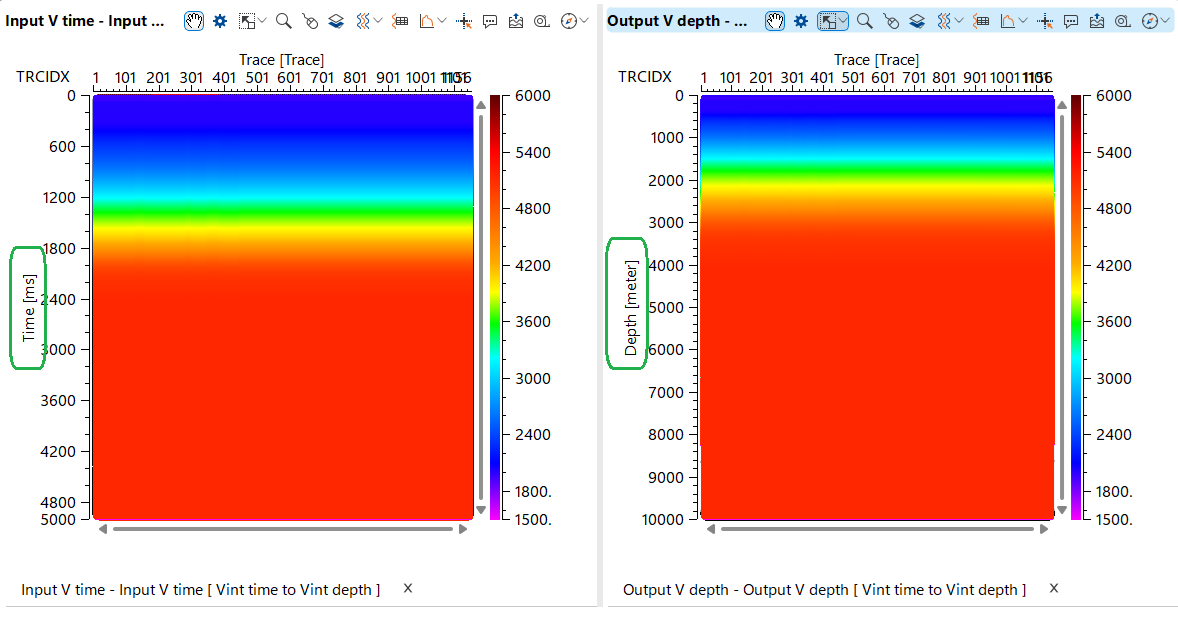
Open visual vista items of input (interval time domain) and output velocities (interval depth domain):
Video lesson
YouTube video lesson, click here to open [VIDEO IN PROCESS...]
Related articles
 If you have any questions, please send an e-mail to: support@geomage.com