Module name AGC
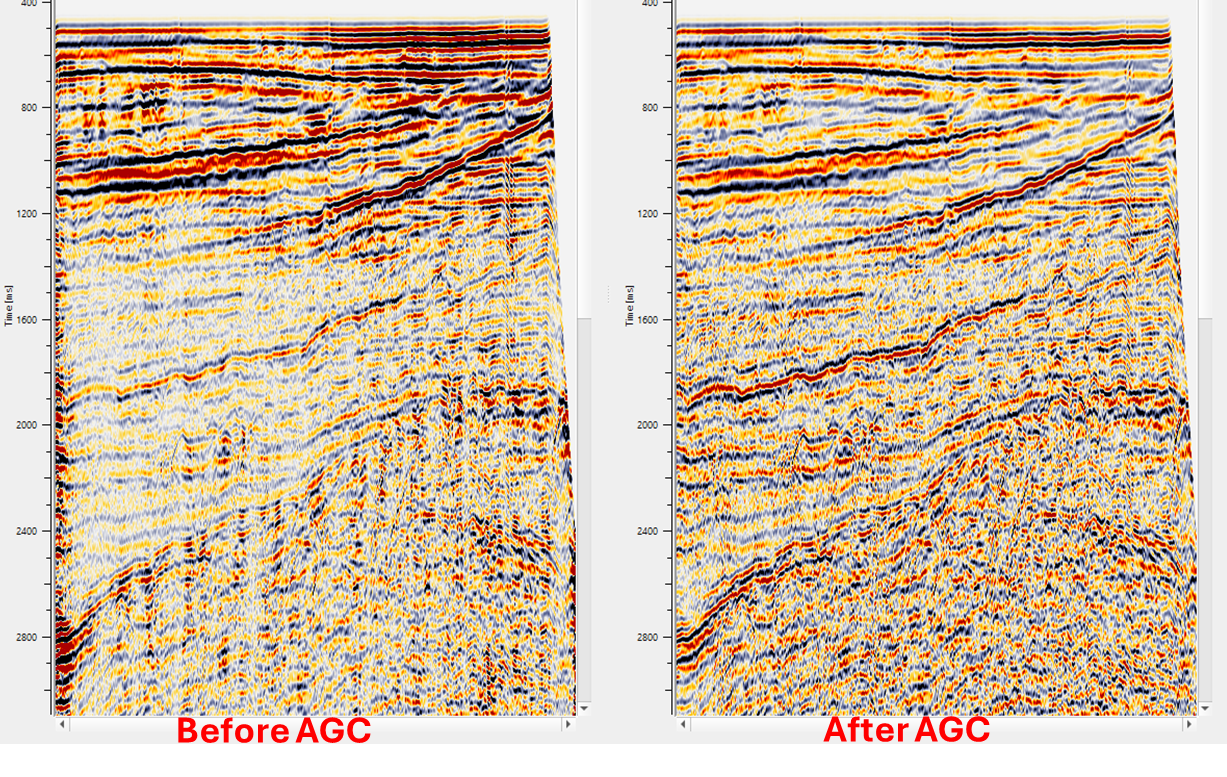
The purpose of AGC is to adjust the strength of seismic signals so that signals of different magnitudes can be analyzed more easily. It works by boosting weaker signals and reducing the intensity of stronger ones, allowing the entire dataset to be viewed and compared on a more consistent scale.
AGC is applied in different ways. Single window, Time variant and Exponential AGC.
Single window - It calculates the gain factor and normalizes the amplitudes within a user specified window by considering the maximum or average amplitudes.
Time variant - It adjusts the gain function dynamically with the time varying characteristics of seismic data
Exponential - It applies an exponential function to control the gain based on the amplitude variation over time.
Mathematically if we write the equation for the AGC,

G(t) or the Gain factor is calculated in various methods. For single window, it is based on the Root Mean Squared (RMS) sliding window method. In this, it calculates the rms or maximum amplitudes of the seismic signal/trace within the user defined window over a time "t".

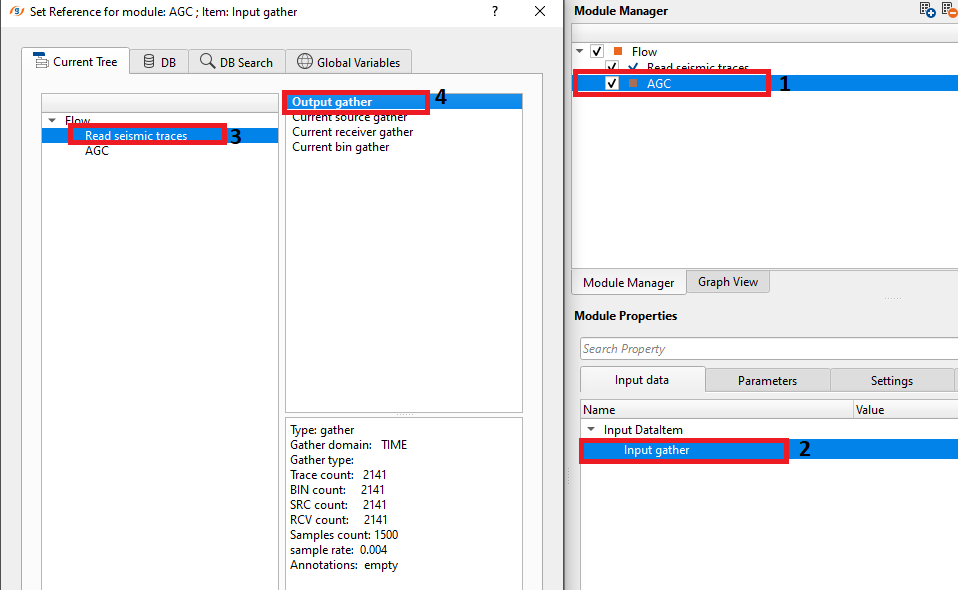
In the example below, we are reading a stack section using "Read seismic traces" and load data to RAM as Yes option. This data doesn't have any AGC applied. Now, we add AGC and reference/connect the Output gather from the "Read seismic traces" module to AGC.