The third iteration of multiple attenuation in our case we produce after migration step. g-Platform provides several radon modules and we are going to use Radon multiple attenuation (high resolution Radon).
Keep in mind that you have several radon modules with a bit different functionality and results:
•Radon multiple attenuation: vista views: input, output, difference gathers, user-defined time curves on gather;
•Radon - TauP - High resolution: vista views: input, output, difference gathers, Tau-P domain, interactive curve on gather;
•Radon - TauP: vista views: input, output, difference gathers, Tau-P domain, interactive curve on gather;
•Radon multiple attenuation by velocity: vista views: input, output, difference, NMO-corrected gathers, interactive velocity spectrum for constrain-polygon picking;
•Radon - by picking: vista views: input, output, difference gathers, interactive Tau-P domain for constrain-polygon picking.
If we are not satisfied with one result, we can try another module or mix them, and create a complex workflow.
Create a new workflow 0170_Multiple_attenuation_(iteration_3).
Add all necessary modules to the workflow:
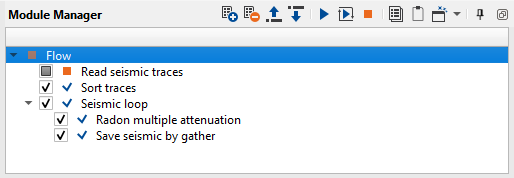
1.Read seismic traces - load traces after migration
2.Sort traces - sort traces by CMP
3.Seismic loop - process every sorted gather in a loop (one by one)
4.Radon multiple attenuation - remove multiples
5.Save seismic by gather - save seismic traces
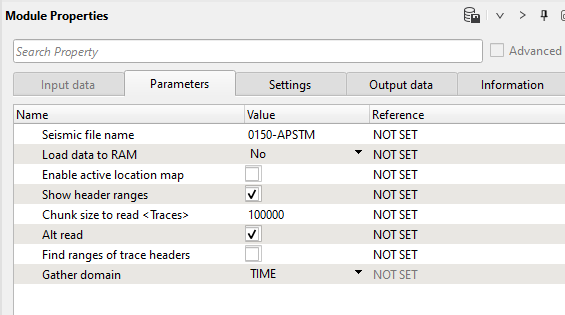
1)Read seismic traces. Load seismic data set after migration 0150-APSTM.
Parameters:
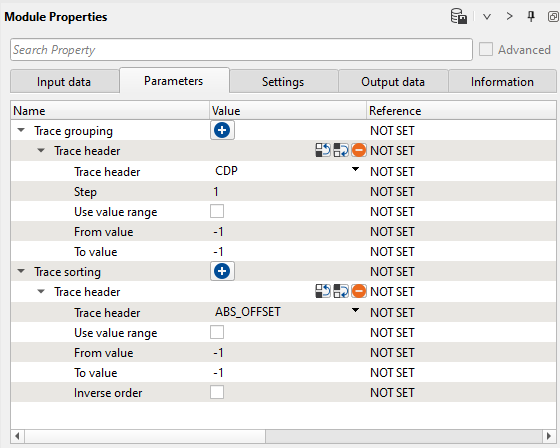
2)Sort traces. Sorting by CDP - offset:
Parameters:
Execute those modules.
3)Seismic loop. Put two modules inside: Radon multiple attenuation and Save seismic by gather.
4)Radon multiple attenuation.
This module transforms seismic traces into Tau/P (intercept time and slowness dt/dx = p) domain where we can easily separate multiples and primaries. Such separation allows to attenuate energy of multiple waves before reverse transformation into time domain (T-X). Basic idea is separation primaries and multiples by their velocity (moveout). Input traces are decomposed so hyperbolic events map to elliptical curves in Tau-P domain.
Input seismic gather must be sorted by Common Middle Point (CMP) - Offsets and the primaries should be flattened by applying Normal Move Out (stack velocity) correction before Radon transform. In this case the primary energy will be near P=0, which produces difference in moveout makes it possible to flatten the primary reflections while leaving the multiples under-corrected with a moveout approximately parabolic.
Slowness = 1 / Velocity
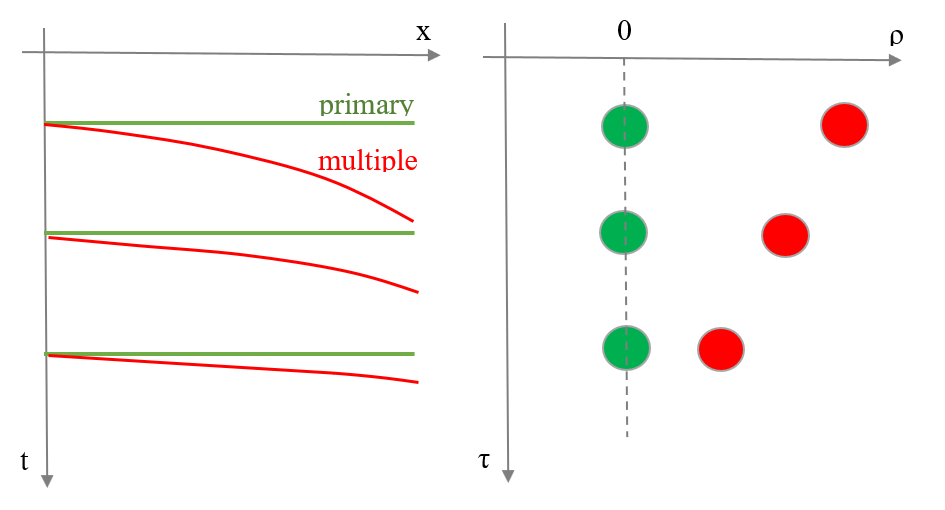
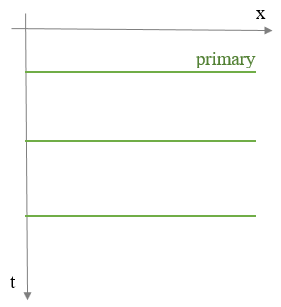
Model of CMP gather: 1) Time domain (T-X): Primaries+Multiples;
2) Tap-P domain: Primaries+Multiples:
3) Time domain (T-X): Primaries.
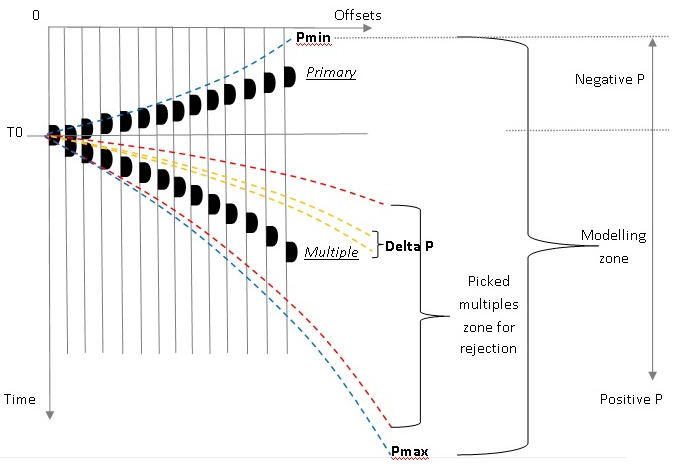
The module performs a model of primary and multiple events. This computation is based on data decomposition into user-defined parabolas and calculated by high-resolution algorithm, de-aliased least-squares method in the frequency space domain for every frequency of the pass-band which is defined by frequency min (Hz) and frequency max (Hz) parameters. Events corresponding to parabolas with a bigger curvature are considered as multiples. Events corresponding to parabolas smaller than this constrain are primary events. The area limits between primaries and multiples is user defined parametrization.
Parameters:
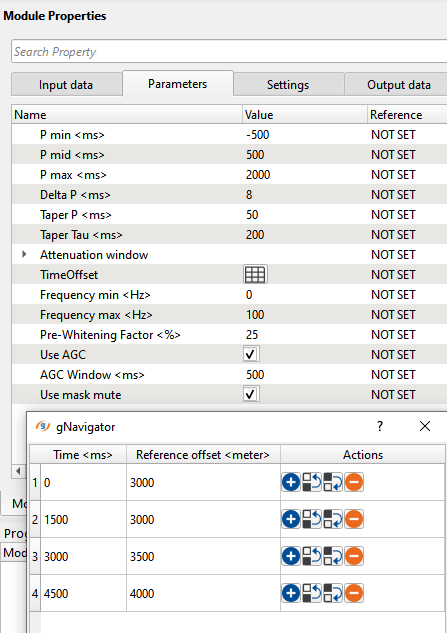
P min
Minimum p-value for transform data from t-x into tau-p domain.
P mid
Middle p-value for transform data from t-x into tau-p domain.
This parameter is start for modeling multiple waves.
P max
Maximum p-value for transform data from t-x into tau-p domain.
(Choose this parameter with care because run time for this process increases with the square of the number of P-values).
Delta P
Amount of modeling waves.
Should be approximately equal signal response time interval.
Taper P
Taper zone between P min/mid/max-values.
Taper Tau
Taper zone between start time - filtered - end time.
TimeOffset
Time varying reference offset for multiple modeling.
Time – time.
Reference offset – reference offset.
Frequency min
Minimum frequency for filtering
Frequency max
Maximum frequency for filtering
Pre-Whitening Factor
Pre-whitening factor for stabilizing tau-p to t-x transformation.
Use AGC
Apply automatic gain control pre radon filtering and remove after radon filtering.
AGC Window
Window for automatic gain control.
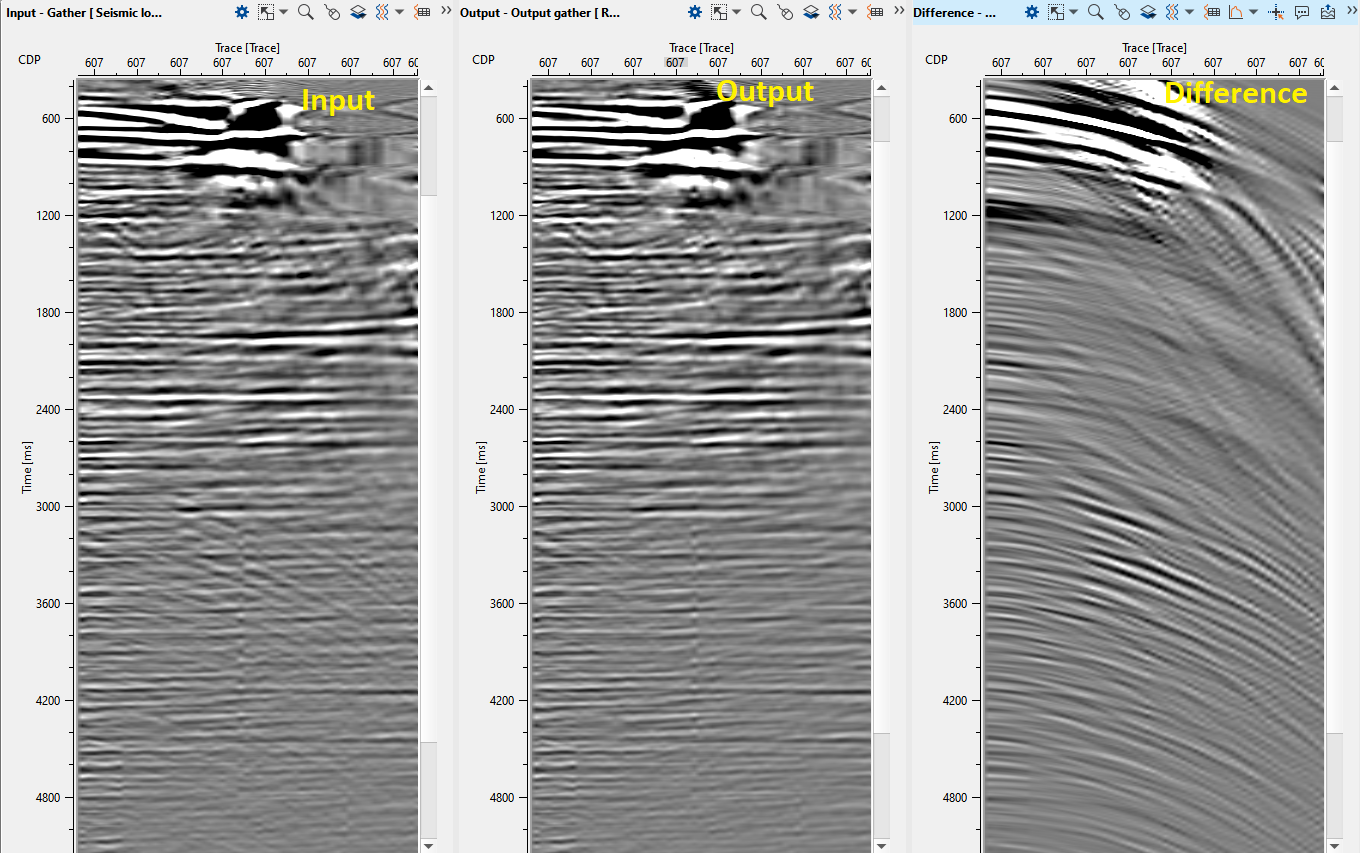
Execute the module and open all vista windows:
5)Save seismic by gather. Define an output file 0160-demultiple2 name. Turn off difference calculations and execute calculations for the entire data set.