Import LAS files
The LOG group of the Wells bar provides two separate buttons for loading LAS files: Load LAS files for a quick, simple load, and Log Loading Wizard for an advanced load with full control over the loading process.
Load LAS files (simple)
Step 1: Locate the file
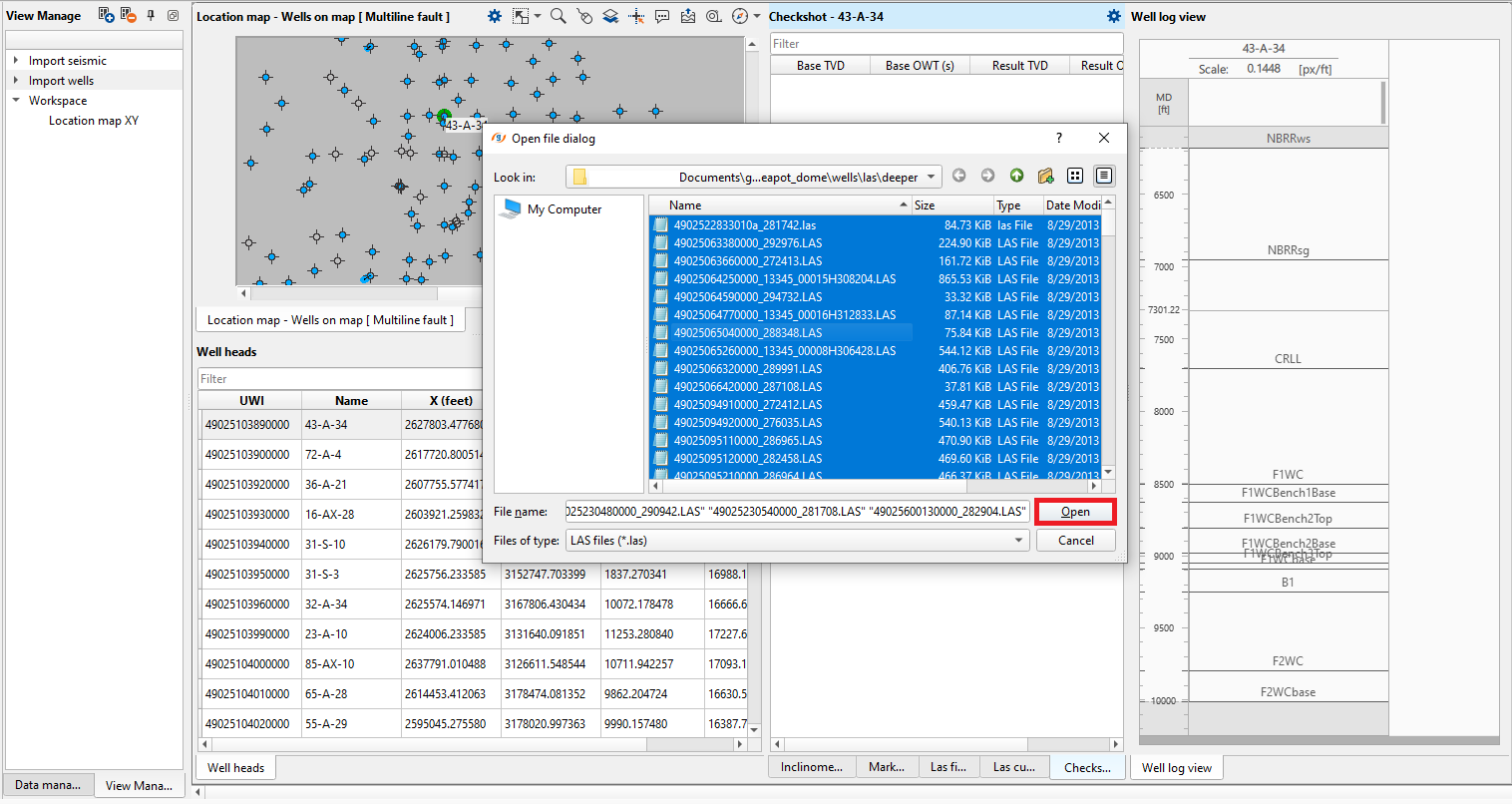
Go to Ribbon -> Wells bar and click on Load LAS files button in the LOG group

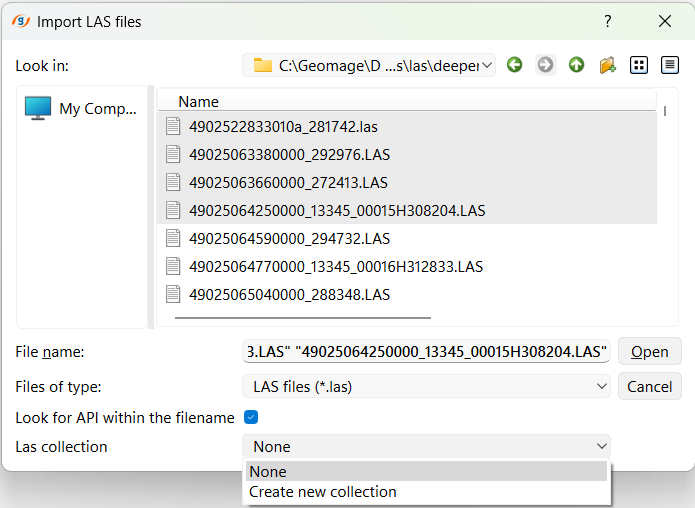
In the appeared dialog box locate the files and click open
The file dialog provides two additional options. Enable Look for API within the filename to extract the well API/UWI from the file name. The Las collection dropdown lets you add the curves to an existing collection or choose Create new collection to place them in a new one.
Step 2: Create wells for unknown UWIs
If a LAS file refers to a UWI that is not in the project yet, g-Space asks whether to create these wells. Answer Yes, then confirm or edit the suggested identifier in the New well name dialog that opens for each file. The value you confirm becomes both the UWI and the name of the new well; leaving it empty skips that file.
For every well created this way, g-Space also fills in the well header from the LAS file, so the values do not have to be entered by hand afterwards. The following Well heads fields are filled in when the file provides them:
- X and Y - the surface location. Both coordinates must be present, otherwise the well is created without a location.
- Kelly bushing (KB).
- Total depth, MD - the total depth from the LAS header, or the deepest logged depth when the header does not state it.
- Ground level (GL). If the file has no ground level, the Kelly bushing value is used.
- Completion date - recognized when written as YYYY-MM-DD, YYYY/MM/DD or YYYYMMDD.
The values are taken from the well information (~W) and parameter (~P) sections of the LAS file, and values written in feet are converted automatically. If the logged data goes deeper than the total depth written in the LAS header, g-Space reports both values and asks Should total depth be updated based on MD if it exceeds the LAS header value? Choose Yes to store the deeper logged depth, or No to keep the header value.
Only wells created during this load receive header values. A well that already exists in the project keeps its current X, Y, Kelly bushing and depth values, and the LAS file simply adds its curves to that well.
Array channels (if present)
During a simple LAS load, a file with array channels opens Array channels before import finishes. Check Kind and choose Borehole image for an image. For a rotating tool, choose From pad-1 azimuth curve in Azimuth of bin 0 from: and select its Pad-1 azimuth curve:. On a new import, selecting the curve alone leaves the source at Constant. If bin 0 does not coincide with pad 1, enter the angle in Bin 0 offset from pad 1:. When the curve has usable samples, image orientation and dip azimuth follow it by depth. The same dialog is used for DLIS arrays; see Import DLIS.
To review the result, open the Wells data workspace and check the Well heads table.
Step 3: Control loaded data
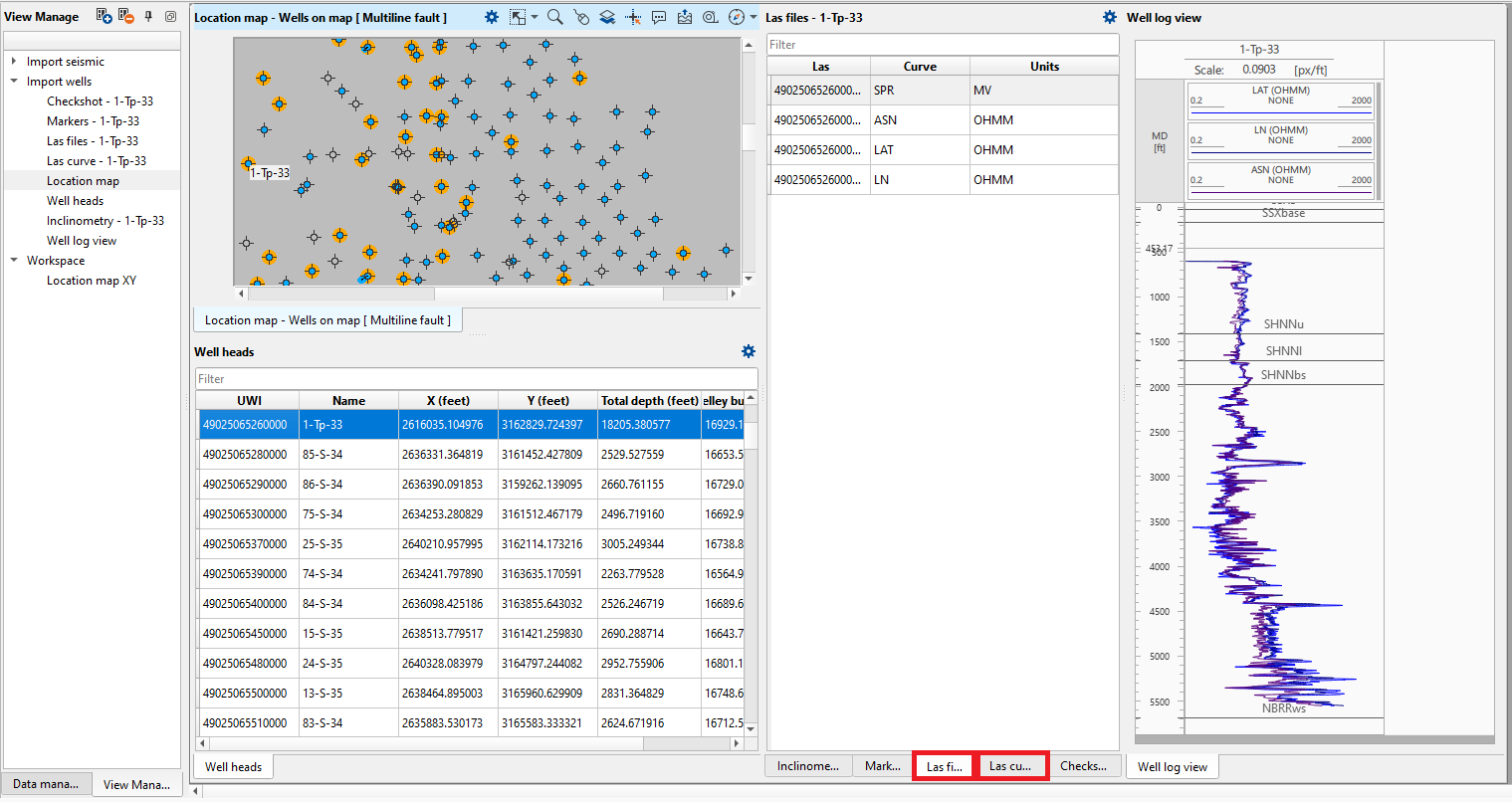
To check Well log data you have just loaded click on map view or in table below map. All loaded information will appear in table LAS files where you can find list of loaded curves. In the table Las curve you can check the log values. Also you can see the log preview
Each loaded curve is listed with its Curve name, the Name from file mnemonic, its Collection, Units, Type and a Histogram preview of the curve values.
The Type column is filled in automatically. While the file is read, g-Space matches the mnemonic and the units of every curve against its log type database, so NPHI in % is recognized as Neutron Porosity and RHOZ in G/CC as Density. A mnemonic that the database does not contain is left as Unknown, which makes the curves that still need attention easy to find. Type is an editable dropdown, so an Unknown or a wrongly recognized curve can be corrected here.
Log Loading Wizard (advanced)
The Log Loading Wizard gives you more control over the loading process. Start it from the LOG group of the Wells bar, next to Load LAS files.
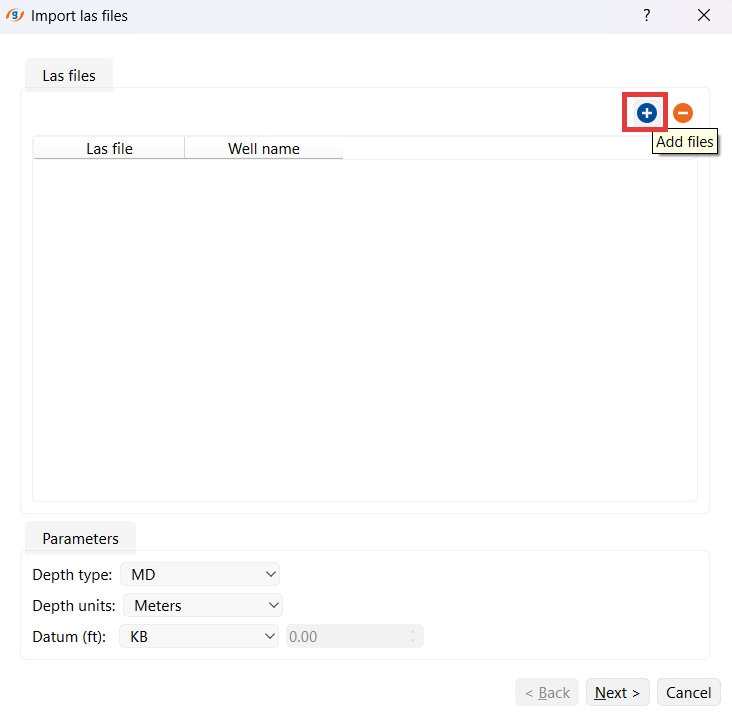
In the Log Loading Wizard window, on the Las files tab, click the + button to add one or multiple LAS files. Every added file appears as a row with a Las file and a Well name column.
Each file has to be assigned to a well. g-Space fills in Well name automatically, matching the file against the project wells by UWI, then by API, then by the well name stored in the LAS header, and finally by a well name contained in the file name. If nothing matches, the cell stays Undefined and you have to select the well yourself in that cell, from a dropdown that lists Undefined and the wells already present in the project and that can be searched by typing. Wells cannot be created from this page, so a missing well has to exist in the project before it can be picked. If any file is still unassigned when you press Finish, g-Space reports Some LAS files are not assigned a well, lists the files concerned and keeps the wizard open.
The Parameters group under the table sets Depth type, Depth units and Datum with its value for all added files at once; these settings can still be adjusted file by file on the next page. Once the files are added, press Next.
A separate Text files tab is available for importing log data from .txt / ASCII files. It uses the same curve-review workflow, with an added separator and column mapping so the wizard can read the curves from a plain text file.
When you add a .txt / ASCII file, an Import log column-mapping dialog opens. g-Space analyses the file and pre-fills the mapping automatically, so a standard log file can be imported with minimal manual editing:
- Separator type - Tab delimited, Space delimited or CSV, detected from the file content.
- Headers row and Start row - the header line and the first data row, detected from the file structure.
- The MD (depth) column and the log Value columns, bound to the matching file columns.
- Mnemonics read from the column headers, with Units filled in where available.
All detected values are only suggestions. You can change the Separator type, Headers row and Start row, edit the fields, mnemonics and units, and use the Add and Remove buttons to add or drop value fields. A preview of the parsed file lets you confirm the mapping before importing.
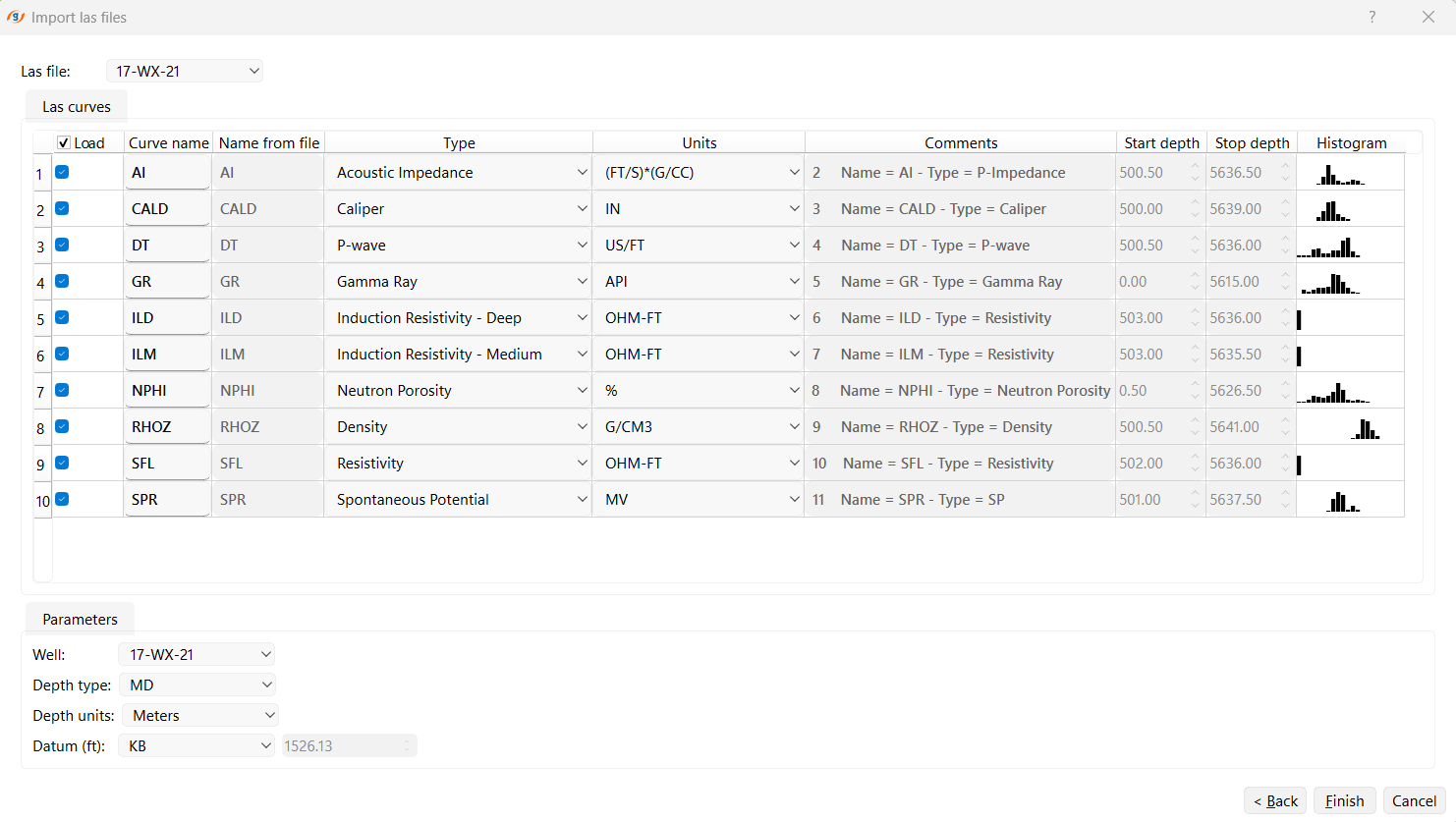
The next page lists the curves of one file in the Log curves table. When several files were added, the Log file dropdown above the table switches between them, so the files are reviewed one at a time on this page and are then loaded together.
Each curve is listed with:
- Load - only the checked curves are imported. The checkbox in the column header selects or clears every curve of the current file at once; if nothing is checked, Finish reports No curves selected.
- Curve name (short code, e.g., GR, DT, NPHI).
- Name from file (original name as stored in the LAS).
- Type (curve type: Gamma Ray, Density, Resistivity, etc.), recognized automatically from the mnemonic and the units of the curve and left as Unknown when the log type database has no matching entry.
- Units.
- Comments.
- Start depth / Stop depth.
- Histogram preview of curve distribution.
Curve name, Type and Units can be changed manually, you can choose the options from the list or type it.
If the well already contains a curve with the same name, the wizard adds a number to the incoming curve, for example DT 1, so that the existing curve is kept. If you edit Curve name back to a name that already exists in that well, the name is shown in red with the tooltip Curve with the same name already exists. Pressing Finish then asks Some curves have the same names, do you want to rewrite them and lists the well, the curve name and the number of curves concerned. Answer Yes to overwrite the existing curves, or No, which is the default, to return to the table and rename them.
When you assign or change a curve Type for a mnemonic (here or later in the Data Manager LAS curve table) and other wells contain the same mnemonic with a different type, g-Space asks Apply this curve type to all curves with the same mnemonic in other wells? Choose Yes to apply the selected curve type to every matching mnemonic in the other wells, or No to change only the current curve. This lets you classify a mnemonic once instead of repeating the assignment well by well.
At the bottom, you can set well-specific parameters that override the values read from the LAS header:
- Well (well name).
- Depth type (MD, TVD, etc.).
- Depth units (Meters, Feet).
- Datum — a dropdown offering KB, Sea level and Manual; the datum is chosen from the list and cannot be typed in. The number on the same row is editable only for Manual and is entered in the depth unit named in the row label, Datum (m) or Datum (ft), which follows the current measurement system. With KB the number is read-only and shows the Kelly bushing from the well header; with Sea level it is a read-only 0. In the all-files Parameters group on the Las files page the dropdown also offers (multiple values) when the added files differ, and the number stays empty for KB.
For more information about formats please refer to Well Data Formats