Export faults
Note
Export faults will be performed on current datum and replacement velocity. To check these values go to Module Properties panel --> Parameters tab
Exporting faults:
On the Interpretation bar, use the Faults Management group. Two export options are available:
Option 1: Press Save faults binary button  and g-Space will export a copy of all faults
Option 2: Press Export current fault (charisma format) button .png) , set the datum and save the file
, set the datum and save the file
Another option is to export faults in Charisma format: In Actions panel choose Export current fault (charisma format)
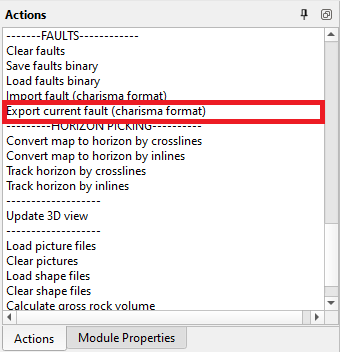
For more information about fault formats supported by g-Space refer to Fault Data Formats
Exporting faults from the Data manager
Faults can also be written to Charisma format directly from the Data manager. In the Faults section, right-click the item you want to export and choose Export > To Charisma...:
One fault - g-Space asks for the datum in the Set the required datum dialog, where Datum is prefilled with the current time or depth datum, then asks for a file name and writes one Charisma file.
Several selected faults - all faults in the selection are exported in one step.
The Faults folder - every fault in the project is exported in one step.
For a selection of faults and for the whole Faults folder, g-Space first asks for a target folder in the Export faults dialog and then asks for the datum once for the whole batch. If any target file already exists, g-Space lists those files and asks whether to overwrite them. One file per fault is written into the chosen folder, named after the fault with the extension .dat; spaces in a fault name are replaced with underscores.
To export a fault's triangulated surface instead of its sticks, expand the fault in the Data manager, right-click its Surface node and choose Export to GOCAD TSurf. See GOCAD Data Formats.