Cross plot view
Cross plot is a view which allows user to cross-plot different data types loaded in g-Space. New cross-plot views are titled Cross-plot analysis; views restored from older projects may keep their saved title.
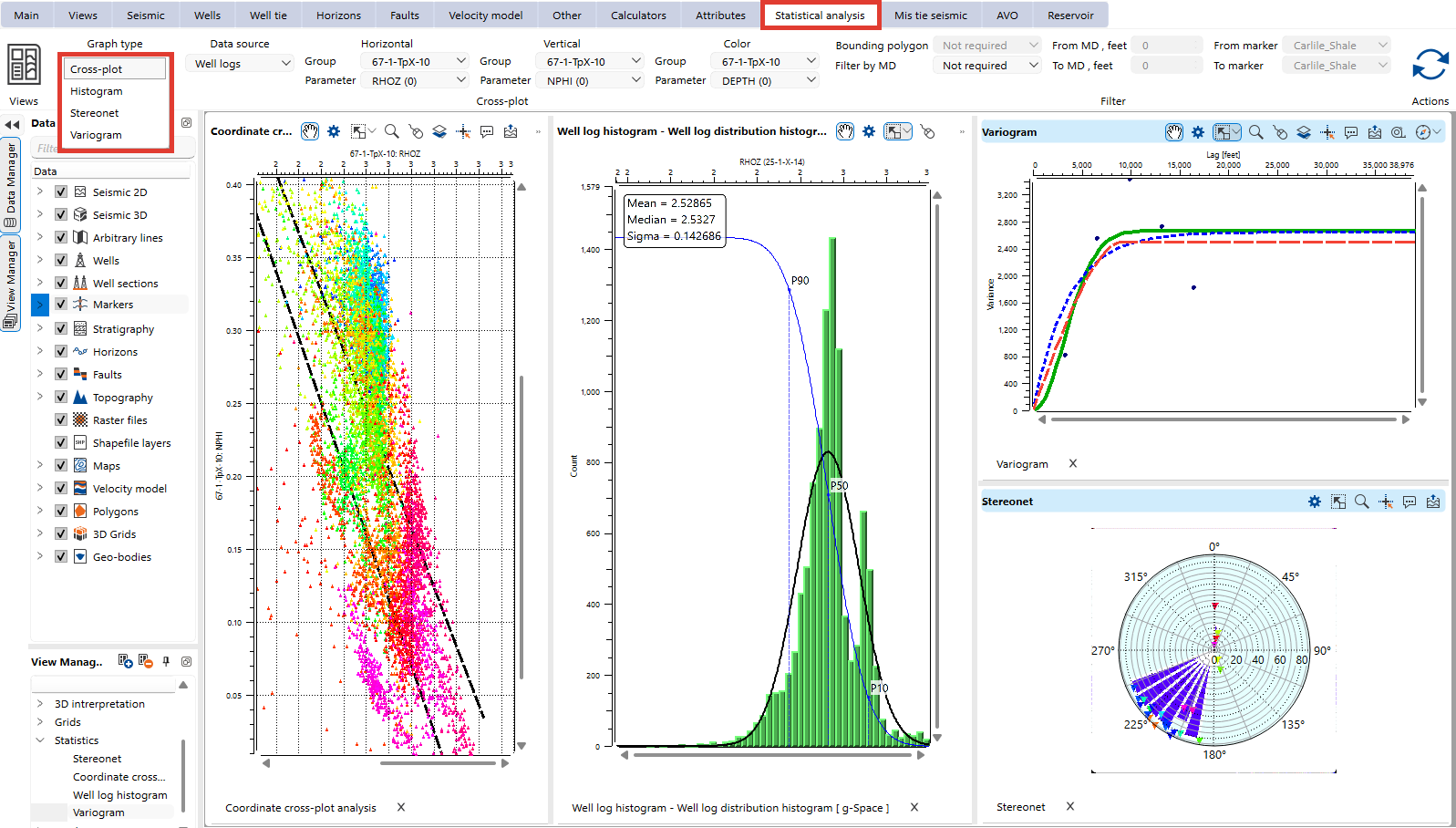
To create cross plot view go to the Views bar, navigate to Graphs and click on Cross plot button:

To set what data to be analyzed set parameters in the Statistical analysis bar:
To define the object visibility stile go to the Visual Settings by pressing  in the view functional panel or find it in the panel sets.
For more information about the cross-plotting please refer to Statistical analysis
Functional panel allows user to perform the following actions:
open Visual Settings panel
 adjust view area to all visible objects
 adjust horizontal scale
 adjust vertical scale
 set/unset zoomable
 set control item
 add Object
 enable mouse tracker
 enable tool tip
 export picture
 ruler tool
Chart library
The Show Charts button on the top toolbar of the Cross plot view opens the Cross-plot Chart library — a catalog of published reference charts that can be overlaid on the current cross-plot.
The dialog lists the available charts and provides the following controls:
- Filter by Units — enabled by default. When on, only charts whose X and Y axis units match the currently selected Horizontal and Vertical parameters are listed. Turn it off to browse all available charts.
- Chart list — select a single chart to overlay it on the cross-plot. Hover over an entry to see its X and Y quantities, units, and source reference.
- Show chart name in legend — adds the selected chart's name to the plot legend.
If you select a chart whose units differ from the current axes, the dialog displays the warning Selected chart units do not match current X-Y units. in red. Selecting a chart updates the overlay immediately; toggling Show chart name in legend updates the legend immediately. Click Apply to reapply the current settings, or Close to dismiss the dialog.
Selection and polygon tools
The top toolbar of the Cross plot view provides interactive tools for isolating and annotating clusters of data points.
Selection tools
The selection tools let you enclose a cluster of points so that the regression is fitted to that subset only. They are grouped under the Selection button on that toolbar, between Show Charts and Draw polygons. Click the arrow at the right edge of the button to pick a shape from the list — the button then shows that shape's icon — or click the icon itself to apply the shape currently shown (Selection: rectangle when no shape is active). Three shapes are available:
- Selection: rectangle
- Selection: circle
- Selection: free-form
When a selection shape is applied, points inside it become active and are used for the linear and quadratic regression calculation, while points outside appear pale and remain inactive. Only one selection shape can be active at a time. The shape is interactive — it can be moved or resized by dragging its handles. Click the active tool again to switch it off and clear the selection.
Draw polygons
The Draw polygons tool lets you create multiple named, coloured polygons for grouping and annotation. Unlike the selection tools, drawn polygons do not change the regression fit. Each polygon can be moved or reshaped, and displays a label with its name, the number of points it contains (N), and the average X and Y values of those points.
Right-click a drawn polygon to Rename polygon..., Change colour... or Delete polygon.