Location map overview
The Location Map is a window that allows users to display and manage loaded GIS-type data, including seismic, well data geometry, polygons, arbitrary lines, maps, horizons, and more.
The Location Map view consists of a map canvas with a coordinate frame and a functional panel at the top of the view.
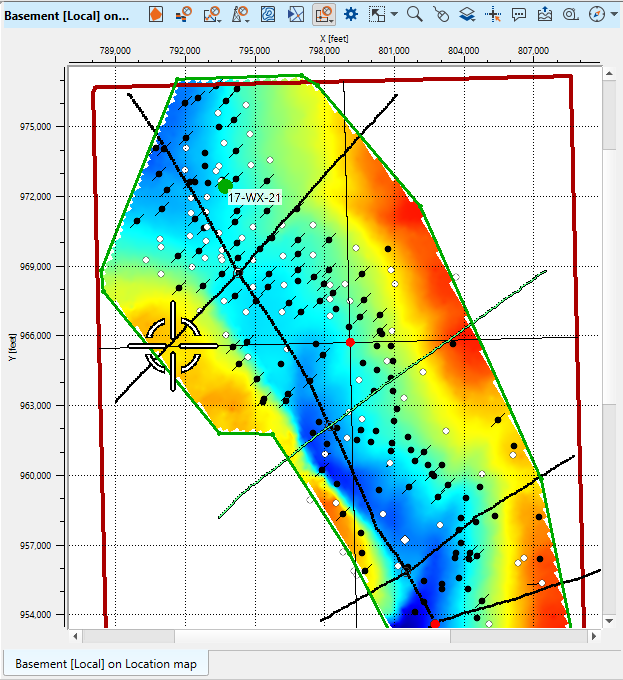
To create location map view go to the Views bar in the Ribbon bar and click on Location map button. A new, empty Location map view opens by default.
The newly created view will appear in the View manager in the active Workspase. User can place location map view by dragging it to any workspace except pre-defined once (Seismic data and Well data).
To define the object visibility style go to the Visual Settings by pressing  in the view functional panel or find it in the panel sets.
On the Location map view user can visualize any object with coordinates. To visualize the object press its checkbox in the Data manager.
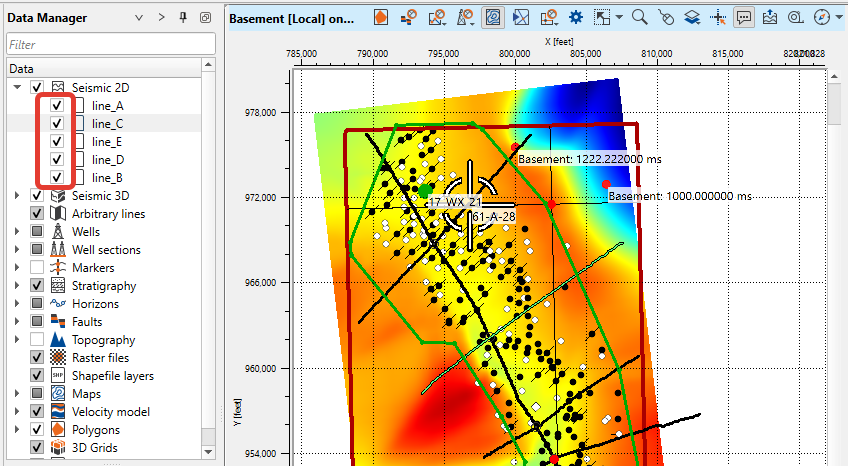
When a fault is ticked in the Data manager, the Location map shows only the fault lines that follow the current horizon and the depth maps: Faults on current horizon, Faults on depth maps, Fault model faults on current horizon, Fault model faults on depth maps and Structural model faults on current horizon.
Extracted fault contact lines have their own visibility control under the source map's Fault contact lines folder in the Data manager. Tick a collection to show its lines on the Location map, or clear it to hide them. See Maps for extraction steps.
The other fault items are switched off by default and stay off when the fault is ticked: All fault sticks, Selected fault map, All faults map, All fault model map, Picked fault bins and Fault picking. Switch them on in Visual Settings on the Object(s) tab.
Every inline and crossline section added under the Sections folder of a 3D survey in the Data manager (IL <number> and XL <number>) is drawn on the Location map as a straight line spanning the survey. A newly added section appears at once; clearing its checkbox hides that line, ticking it shows the line again, and Remove deletes the item together with its line.
These lines form the All sections XY object in the Seismic folder of Visual Settings on the Object(s) tab. Drag a section line on the map to move the section to the nearest inline or crossline; its item in the Data manager is renamed to the new line number. The Selected Inline <number> and Selected Crossline <number> items are not part of All sections XY and keep showing the currently selected inline and crossline.
On the Location map the current time or depth slice of a 3D seismic volume is switched off by default. Ticking the volume in the Data manager does not show the slice: switch it on in Visual Settings on the Object(s) tab. Clearing the checkbox of the volume hides the slice again. A project saved with an earlier version of g-Space opens with this slice switched off.
Saved Time and Depth slices in a survey's Sections folder are separate from the current volume slice. Select the slice's checkbox in the Data manager to show its raster, and select its row to make it active. With the Location map active, press Page Up or Page Down to move it by the configured time or depth step. The map extent stays fixed, and quick repeated presses settle on the last requested level. Moving to another level requires an available source volume; the saved raster remains displayable without it. Save the project after the new raster appears to keep that level. The same keys move an active added inline or crossline section by its configured line step; a selected arbitrary line keeps its existing key behavior. See Data manager for saved-raster and source-warning details.
Functional panel allows user to perform the following actions:
 edit polygon
 edit fault
 edit 2D arbitrary line
 edit 3D arbitrary line
 current well on map
 edit well section
 edit checkpoints
 select intersection
 select 2D/3D/image bin
open Visual Settings panel
 adjust view area to all visible objects
 set/unset zoomable
 set control item
 add Object
 enable mouse tracker
 enable tool tip
 export picture
 ruler tool
 show compass
 show minimap
 show scale bar
Right-click the selected bin marker placed with the select 2D/3D/image bin tool to get Navigate to selected line in data manager for a selected 2D line and Navigate to selected volume in data manager for a selected 3D bin; a marker that carries both offers both commands. Right-click the current well marker placed with the current well on map tool to get Navigate to selected well in data manager. The chosen command reveals the object in the Data manager: it selects the row under Seismic 2D, Seismic 3D or Wells, expands its parent folders and scrolls the tree so that the row is visible.
Object Item Properties Overview
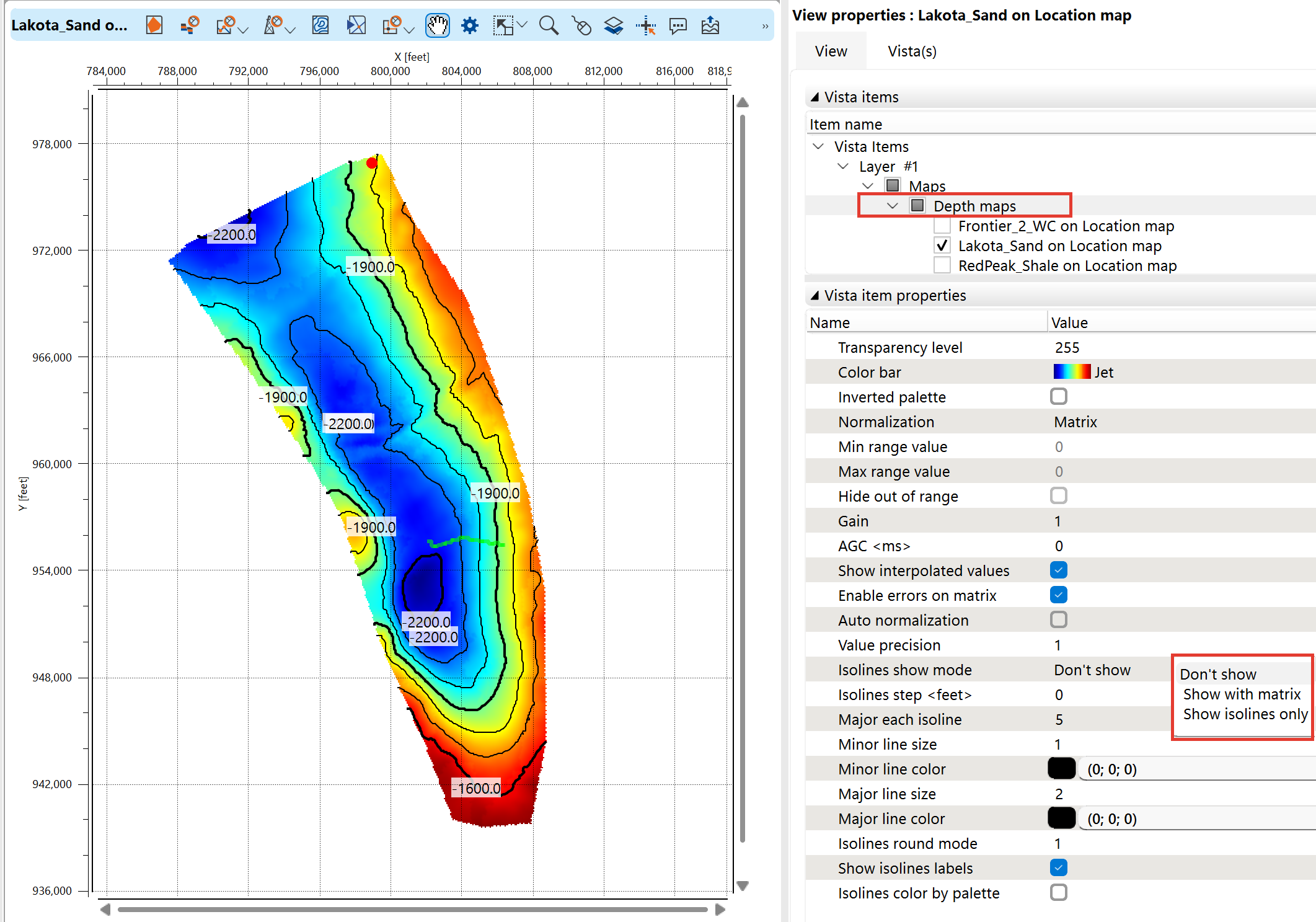
Transparency Level
- Adjusts the transparency of the displayed map.
- Range: 0 (fully opaque) to 255 (fully transparent).
Color Bar
- Defines the color scale applied to the map.
Inverted Palette
- Reverses the color gradient of the selected color bar.
Normalization
- Defines how data values are normalized for color mapping.
- Options include Matrix (based on grid values).
Min/Max Range Value
- Allows users to manually set the minimum and maximum values for the color scale.
Hide Out of Range
- If enabled, values outside the defined range are hidden instead of clamped to min/max values.
Gain
- Adjusts the brightness of the map, affecting contrast between colors.
AGC (Automatic Gain Control)
- Affects amplitude scaling by normalizing the dynamic range.
- Measured in milliseconds.
Show Interpolated Values
- Enables the display of interpolated values in between original grid points.
Enable Errors on Matrix
- Highlights areas where the data matrix has inconsistencies or missing values.
Isoline Settings
Isolines show mode
- Controls the visibility of contour lines (isolines) on the map. Newly displayed maps use Show with map by default, so a depth or time map is drawn together with its contour lines as soon as it is displayed. Isoline settings stored as defaults by an earlier version of g-Space are no longer applied, so these built-in defaults are used after an upgrade as well.
- Don't show – No isolines are displayed.
- Show with map – Isolines appear over the color-mapped grid.
- Show isolines only – Displays isolines without the underlying color matrix.
Isolines step
- Defines the interval between adjacent isolines in the unit shown with the control, which the row name gives as Isolines step <meter> on a depth map or Isolines step <ms> on a time map. A smaller value increases the density of isolines. A newly displayed map starts with a step of 100 in that unit; the screenshot above shows the untouched isoline defaults of a depth map. You can change the value as needed.
Major each isoline
- Defines how frequently a thicker major isoline appears (e.g., every 5th isoline).
Minor Line Size & Color
- Adjusts the thickness and color of minor isolines.
Major Line Size & Color
- Adjusts the thickness and color of major isolines.
Isolines Round Mode
- Controls rounding behavior of isoline values.
- A higher round mode reduces precision but simplifies contour labels.
Show isolines labels
- Choose No labels, Major only, or All. Newly displayed maps use Major only.
- For label spacing, size, color, rotation, and orientation controls, see Map editing.
Isolines Color by Palette
- If enabled, isoline colors match the underlying color map instead of using a fixed color.