QC attributes per trace
Displays QC Attributes on a location map
Theory
QC attributes per trace module is designed to display color maps of various calculated attributes. The attributes are calculated inside the area defined by the Signal analysis window and inside the noise analysis window.
Unlike the QC attributes module, this module calculates the attributes for each trace in the input dataset.
- Go to the respective location map. In this example, we are going to Bin location map, and click anywhere on the location map.
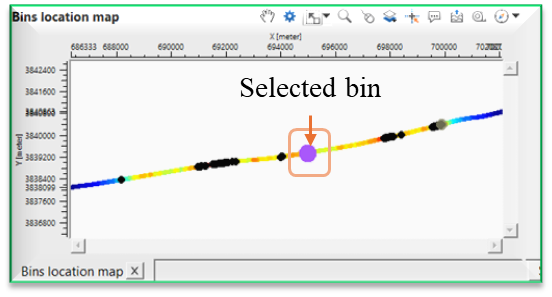
- Selected bin gather will be displayed in a new window.
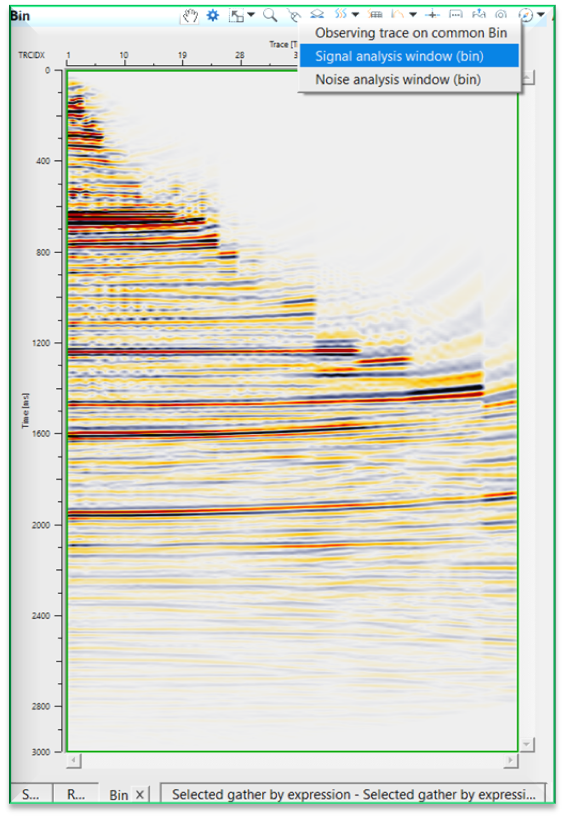
- Go to Control item
 icon and select the options available. Signal analysis window or noise analysis window (as shown above)
 - Hold MB1 or LMB and choose the area and draw a rectangle and it will display the signal analysis window (green rectangle).
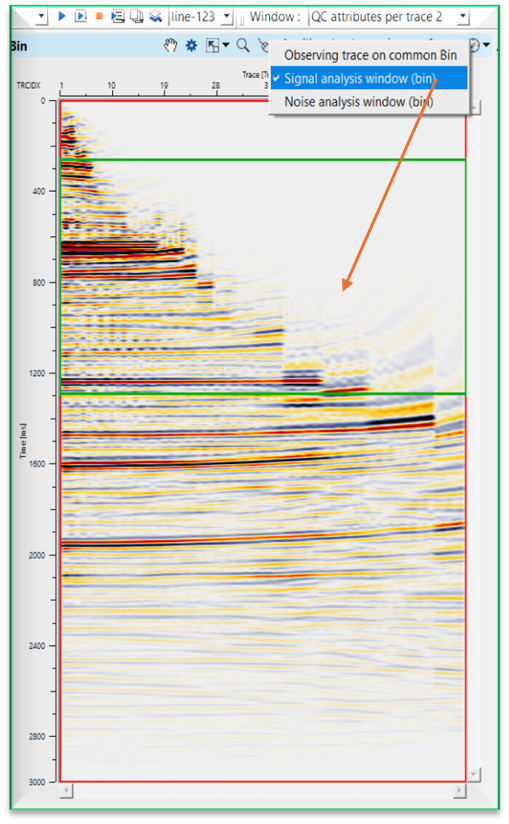
- Likewise the user can do the same for Noise analysis window. These windows values are automatically updated in the parameters as the per selected windows.
- After executing the workflow, it will display source, receiver, bin location map where the calculated attributes are displayed in the respective location map.
Input data
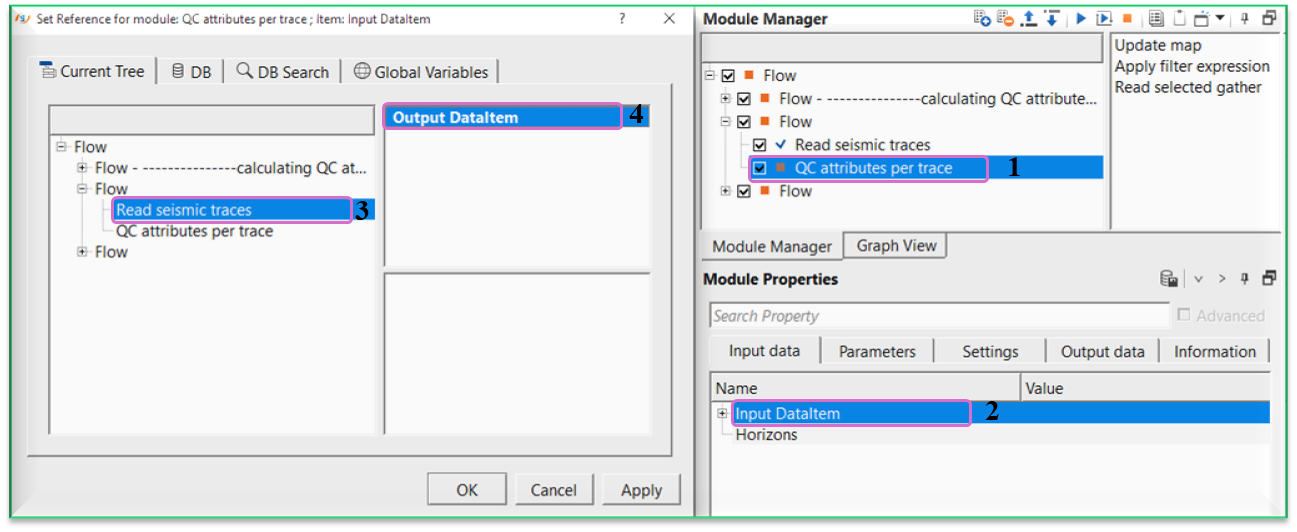
Input DataItem
Input SEG-Y data handle
this can be a pre-stack or post-stack dataset. Connect/reference to the Output SEG-Y data handle.
Input trace headers
connect/reference to the Output trace headers.
Horizons
this is applicable when the input data is post-stack data. Connect/reference to Output horizons. These horizons are used to define the signal and noise analysis windows on the basis of horizons which acts as starting and ending windows.
Parameters
Domain { Prestack, Poststack } - specifies whether spectral attributes are calculated on prestack gathers (e.g., shot, CMP, offset) or on poststack stacked data. By default, Prestack.
Domain - Prestack
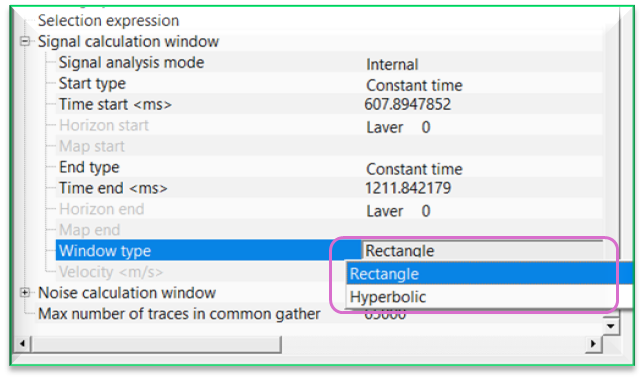
Window type { Rectangle, Hyperbolic } - selects the geometric shape of the calculation window in the time–offset domain. By default, Rectangle.
Window type - Rectangle - uses constant time limits across all offsets.
Window type { Rectangle, Hyperbolic }
Window type - Hyperbolic - defines the calculation window along a hyperbolic travel-time curve based on a specified velocity. Typically used to align with reflection events.
Velocity - defines the stacking or moveout velocity (m/s or ft/s) used to generate the hyperbolic window. Required when Window Type is set to Hyperbolic.
Calculate attributes
this section deals with attribute calculation. Select the desired/required attributes. By default, it will select and calculate all the available attributes from the list.
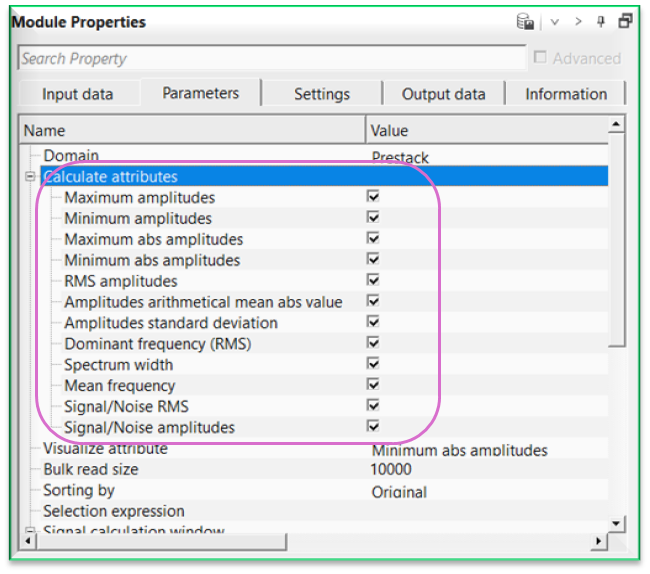
Maximum amplitudes - returns the highest positive amplitude value within the selected time window. Useful for detecting strong reflections or amplitude clipping.
Minimum amplitudes - returns the lowest (most negative) amplitude value within the selected window.
Maximum abs amplitudes - returns the largest amplitude magnitude regardless of polarity. Useful for identifying extreme signal or noise spikes.
Minimum abs amplitudes - returns the smallest amplitude magnitude within the selected window. Useful for detecting dead or muted traces.
RMS amplitudes - calculates the root-mean-square amplitude within the selected window. Represents overall signal energy.
Amplitudes arithmetical mean abs value - computes the average of absolute amplitudes. Provides a stable measure of average signal strength.
Amplitudes standard deviation - measures the variability of amplitudes around the mean. Higher values indicate greater amplitude fluctuations.
Dominant frequency (RMS) - calculates energy-weighted RMS frequency of the amplitude spectrum. Represents the dominant frequency content of the trace.
Spectrum width - measures spectral bandwidth around the mean frequency. Indicates frequency spread and resolution potential.
Mean frequency - calculates the amplitude-weighted average frequency of the trace spectrum.
Signal/Noise RMS - computes the ratio of RMS amplitude inside the signal window to RMS amplitude inside the noise window.
Signal/Noise amplitudes - calculates amplitude ratio between signal and noise windows. Higher values indicate cleaner data.
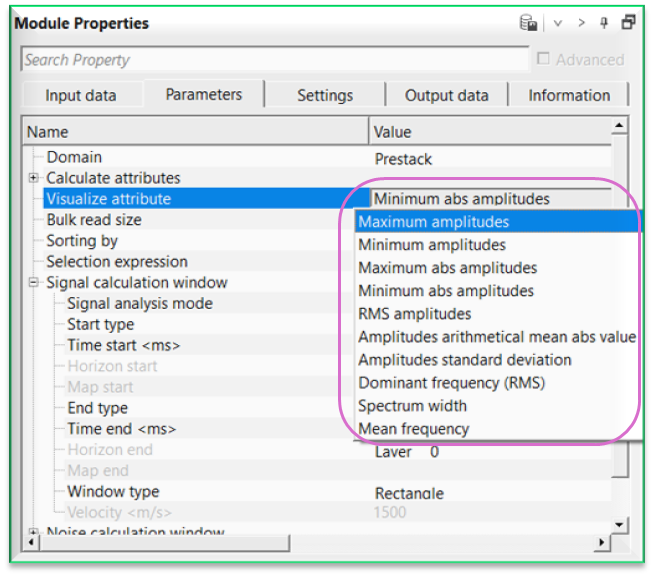
Visualize attribute { Maximum amplitudes, Minimum amplitudes, Maximum abs amplitudes, Minimum abs amplitudes, RMS amplitudes, Amplitudes arithmetical mean abs value, Amplitudes standard deviation, Dominant frequency (RMS), Spectrum width, Mean frequency, Signal/Noise RMS, Signal/Noise amplitudes }
displays the current calculated attribute as a map. By default, Maximum amplitude.
Bulk read size
specifies the total number of traces to read as a bulk.
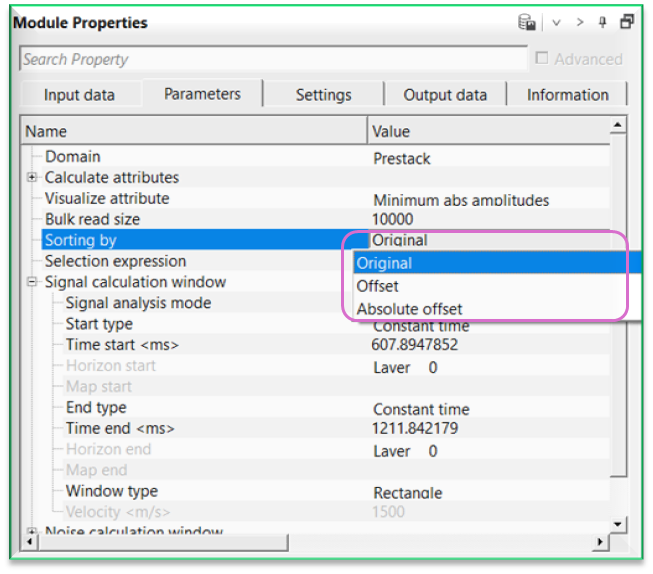
Sorting by { Original, Offset, Absolute offset }
this will sort the input data as per the selection from the drop down menu. By default, Original.
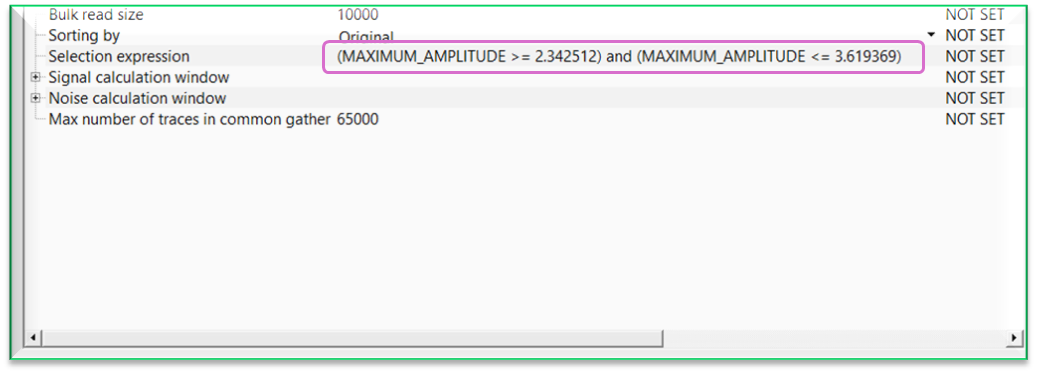
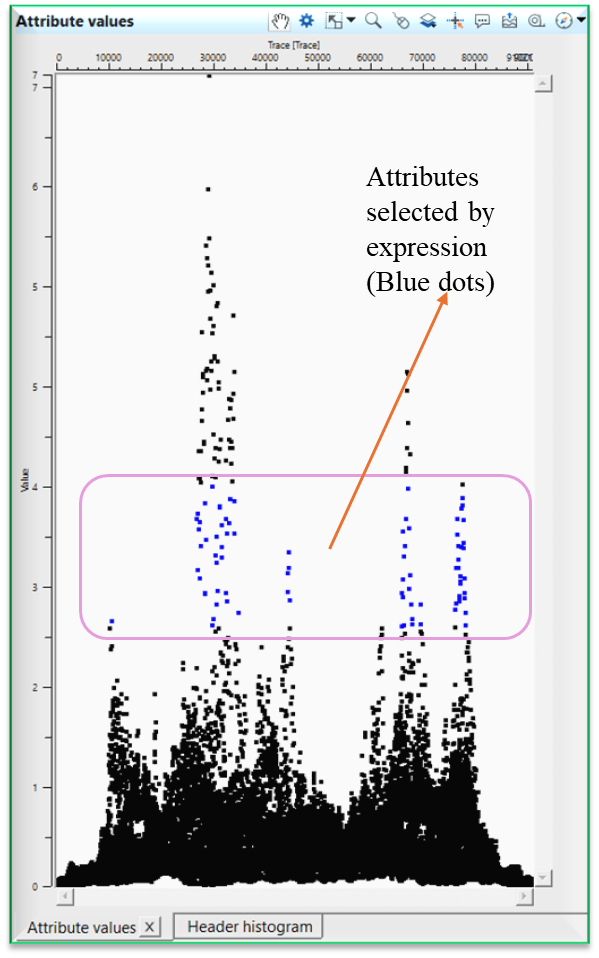
Selection expression
specify the expression with specific attribute values to narrow down the outliers or display the desired value of attributes .
Signal calculation window
this section deals with signal calculation window.
Signal analysis mode { Internal, Around horizon }
select the analysis mode from the drop down menu. By default, Internal.
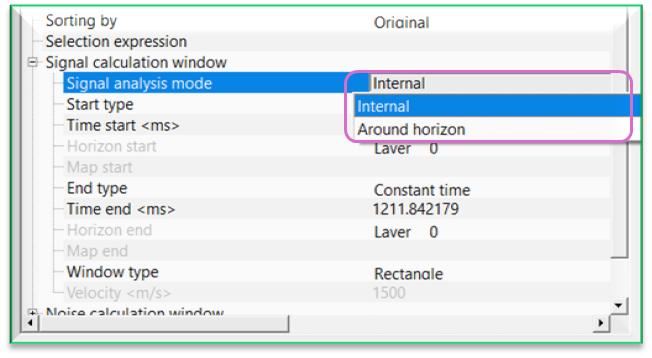
Signal analysis mode - Internal
Start type { Constant time, Horizon, Map }
in case of the internal analysis window, select the start window from the available options in the drop down menu. By default, Constant time.
Start type - Constant time
Time start - defines the beginning time (in ms) of the calculation window. Samples before this time are excluded from attribute computation.
End type { Constant time, Horizon, Map }
End type - Constant time
Time end - defines the ending time of the calculation window. Samples after this time are excluded from calculations.
Start type - Horizon
- this option is applicable for post-stack data. The user has to provide the horizons at the input data level.
Horizon start { }
select the horizon from the drop down menu. The selected horizon acts as a start time window for signal analysis.
End type - Horizon
Horizon end { }
select the horizon from the drop down menu. The selected horizon acts as a end time window for signal analysis.
Start type - Map
Map start
connect/reference to any map which can be used as a starting time. This map can be a topography map etc.
End type - Map
Map end
connect/reference to any map which can be used as a ending time. This map can be a topography map etc.
Signal analysis mode - Around horizon
this option allows the user to analyze the noise within user defined base horizon with a lower and upper limits.
Base horizon { }
select the base horizon.
Upper window
this will acts as a upper window from the base horizon. By default, 50 ms which means the signal analysis window starts 50 ms above the base horizon.
Lower window
this will acts as a lower window from the base horizon. By default, 50 ms which means the signal analysis window starts 50 ms below the base horizon.
Noise calculation window
this section deals with noise calculation window.
Noise analysis mode { Internal, Around horizon }
select the analysis mode from the drop down menu. By default, Internal.
Noise analysis mode - Internal
Start type { Constant time, Horizon, Map }
there are three types. Choose the one from the drop down menu. By default, Constant time.
Start type - Constant time
Time start - defines the beginning time (in ms) of the calculation window. Samples before this time are excluded from attribute computation.
End type { Constant time, Horizon, Map }
End type - Constant time
Time end - defines the ending time of the calculation window. Samples after this time are excluded from calculations.
Start type - Horizon
Horizon start { }
select the horizon from the drop down menu. The selected horizon acts as a start time window for noise analysis.
End type - Horizon
Horizon end { }
select the horizon from the drop down menu. The selected horizon acts as a end time window for noise analysis.
Start type - Map
Map start
connect/reference to any map which can be used as a starting time. This map can be a topography map etc.
End type - Map
Map end
connect/reference to any map which can be used as a ending time. This map can be a topography map etc.
Noise analysis mode - Around horizon
this option allows the user to analyze the noise within user defined base horizon with a lower and upper limits.
Base horizon { }
select the base horizon.
Upper window
this will acts as a upper window from the base horizon. By default, 50 ms which means the signal analysis window starts 50 ms above the base horizon.
Lower window
this will acts as a lower window from the base horizon. By default, 50 ms which means the signal analysis window starts 50 ms below the base horizon.
Max number of traces in common gather
specify the maximum number of trace in the common gather. By default, 65000.
Settings
Auto-connection
By default, TRUE(Checked).It will automatically connects to the next module. To avoid auto-connect, the user should uncheck this option.
SEG-Y read params
parameters for setting advanced parameters of reading seismic traces from disk.
Thread count (for SSD)
amount of treads for reading seismic traces from disk.
Bulk size (traces)
size of a chunk (data portion) for reading seismic traces from disk.
Number of threads
One less than total no of nodes/threads to execute a job in multi-thread mode. Limit number of threads on main machine.
Skip
By default, FALSE(Unchecked). This option helps to bypass the module from the workflow.
Output data
Output calculated attributes
outputs the calculated QC attributes.
Common source gather
outputs common source gather as a vista item
Common receiver gather
outputs common receiver gather as a vista item
Common bin gather
outputs common bin gather as a vista item
Selected gather by expression
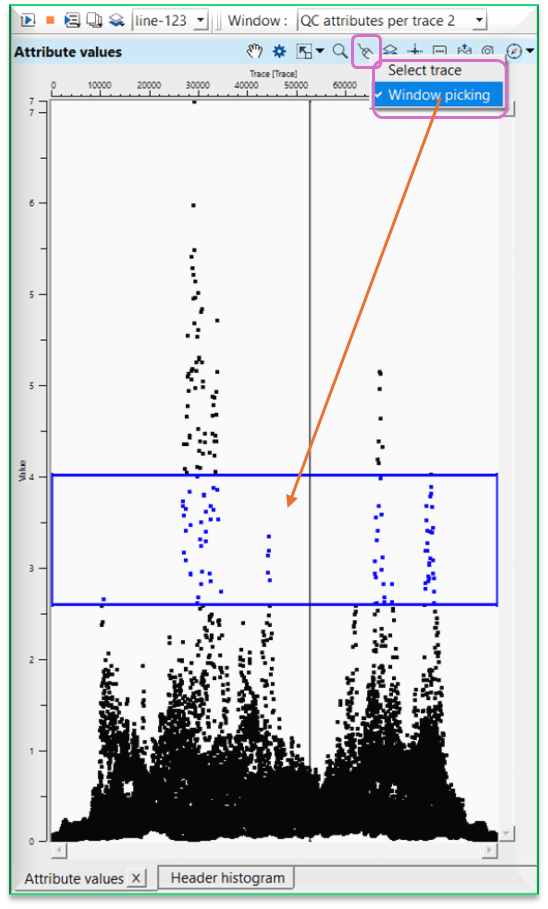
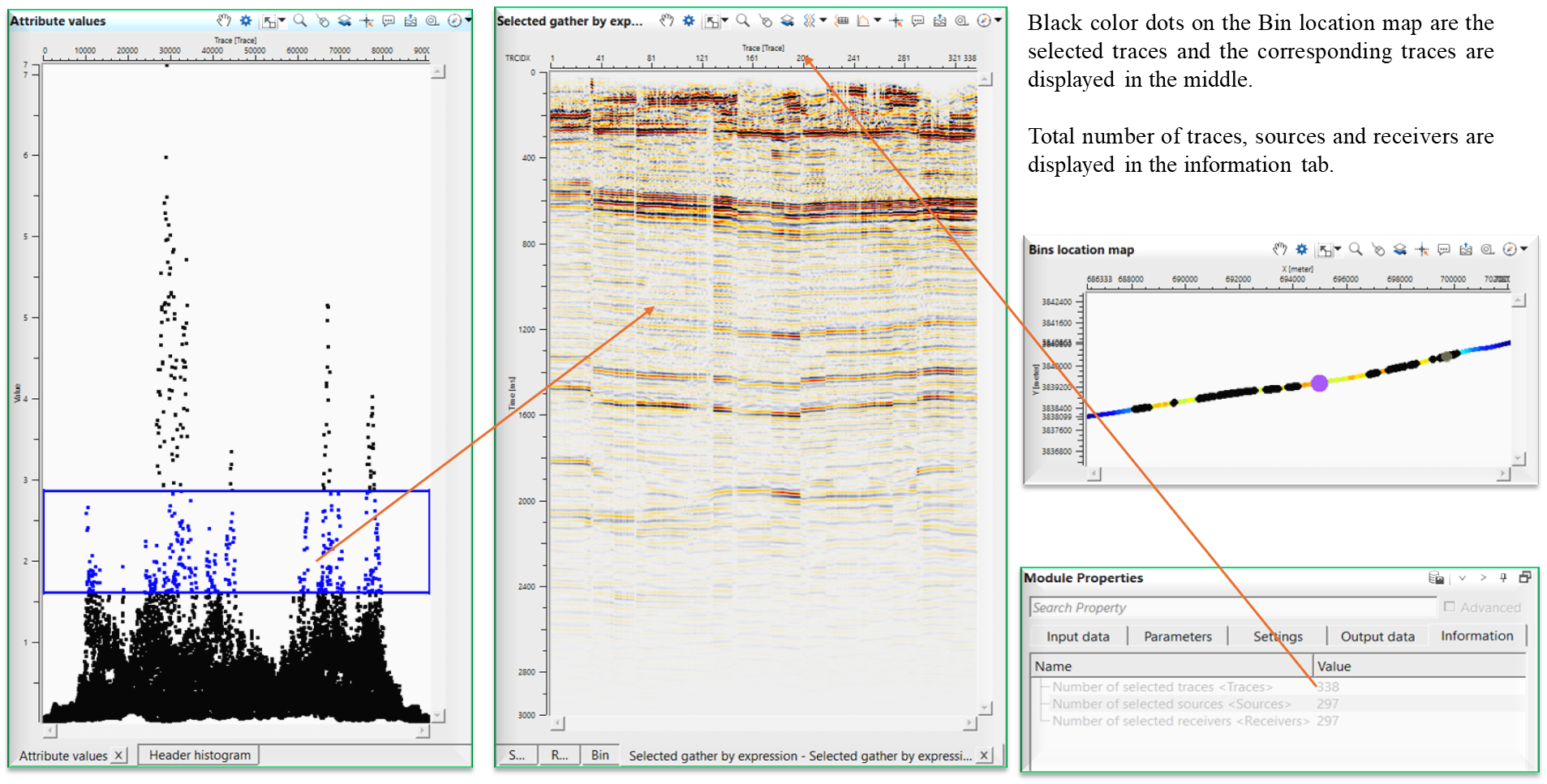
displays the selected gathers by expression as an output vista item. This can be achieved by selecting the traces in the Attributes window and select "Window picking" option.
Information
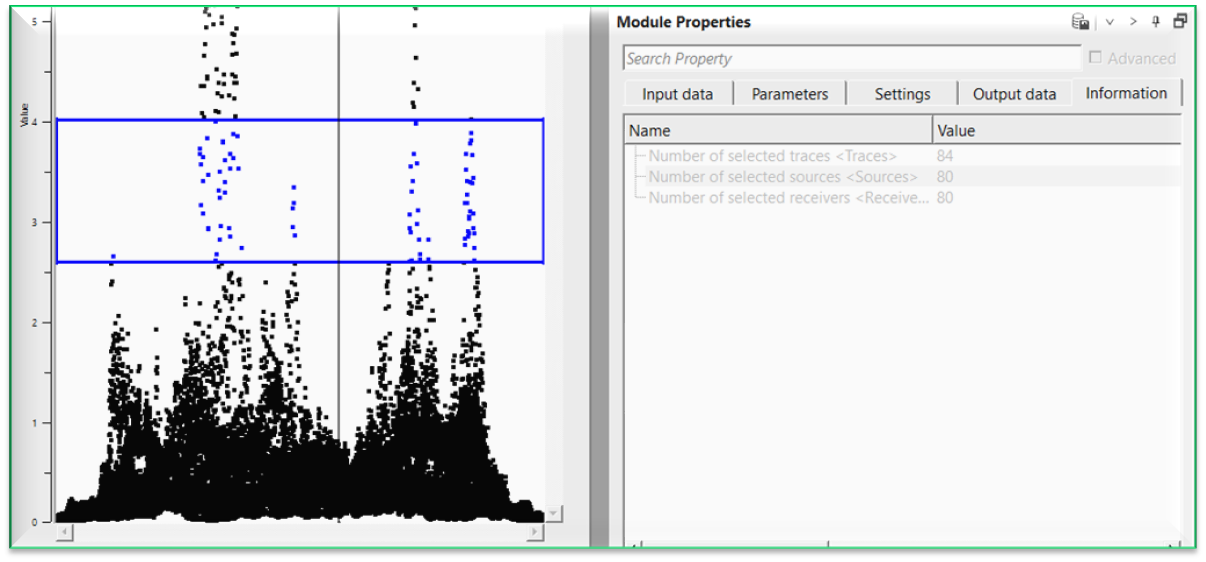
Number of selected traces
displays total number of selected traces from the Attributes values display window by using the Windows picking option.
Number of selected sources
displays total number of selected source from the Attributes values display window by using the Windows picking option.
Number of selected receivers
displays total number of selected receivers from the Attributes values display window by using the Windows picking option.
Examples
In this example workflow, we read pre stack data and calculate the QC attributes for each trace. For this exercise, the input data shouldn't require sorting of the traces.
We need Read seismic traces and QC attributes per trace as the two modules in this workflow.
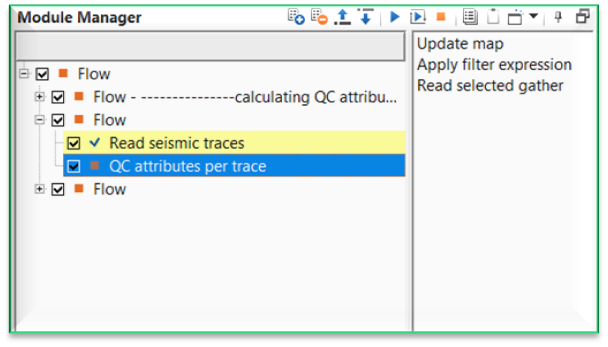
Make the necessary connections/reference to QC attributes per trace module.
Adjust the parameters as per the requirement. Execute the module and it will generate the Source location map, Receiver location map, Bin location map, Attributes, Histogram, Selected source gather, Selected receiver gather, Selected bin gather, Selected expression gather vista items.
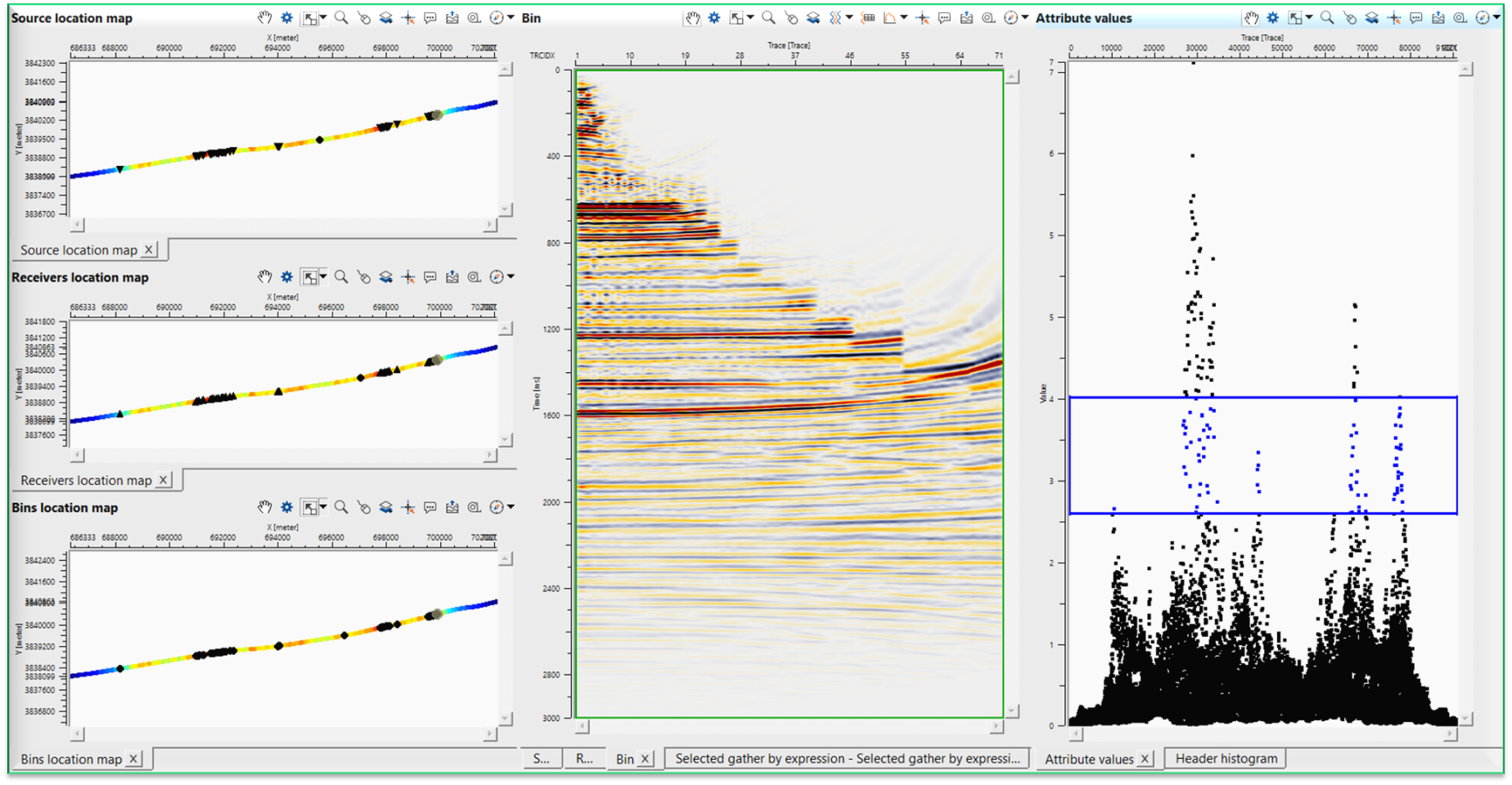
By using the action items and select expression, the user can display the selected gather by expression.
For this to perform, the user first go to Attributes values window and select the Window picking item from the Control item icon (as shown below).
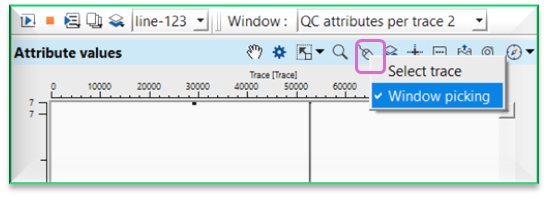
From the calculated attribute values, with Window picking option is active, now the user can select any traces within the window.
Actions
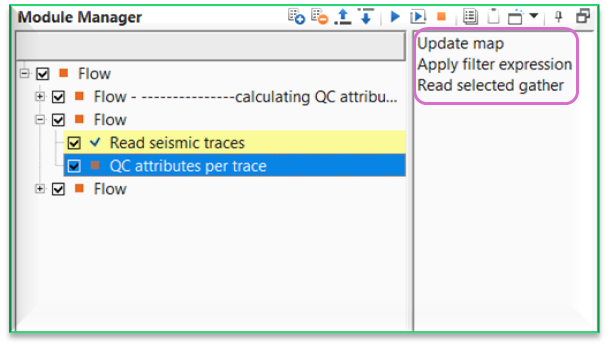
Update map
this will refresh the location map in case it is not properly displayed or update the display when the user changed the different attributes.
Apply filter expression
his is applicable when the user used "selection expression" parameter to filter any of the attributes. This will perform that task.
Read selected gather
this action item reads the selected gather from the location map.
Video lesson
YouTube video lesson, click here to open [VIDEO IN PROCESS...]
Related articles
Yilmaz. O., 1987, Seismic data processing: Society of Exploration Geophysicist
 * * * If you have any questions, please send an e-mail to: support@geomage.com * * *